

Views: 0 Author: Site Editor Publish Time: 2026-07-31 Origin: Site


Inefficient crushing, poor particle shape, and excessive downtime often stem from a fundamental misunderstanding of crushing chamber dynamics. When aggregates come out flaky or production drops, operators frequently blame the machine itself. However, the root cause usually lies inside the chamber. The cone crusher serves as a vital secondary or tertiary asset in your operation. Size reduction here relies entirely on the continuous compression between two critical crusher liners. If you ignore how these wear parts function, downtime will quickly erode your profitability.
Understanding the functional differences, wear patterns, and proper pairing of the Cone Crusher Mantle and Bowl Liner is essential. This knowledge dictates your operation's overall output quality. By mastering these dynamics, you can optimize cost-per-ton and make evidence-based procurement decisions. We will explore how these specific castings interact. You will learn to evaluate materials, select optimal profiles, and time your maintenance cycles correctly.
The mantle is the moving component on the crusher head; the bowl liner (concave) is the stationary component fixed to the upper frame.
Selecting the right crusher liners requires matching the chamber profile (coarse, medium, or fine) to the specific feed size and desired output.
Manganese steel grade selection must align with the abrasiveness of the rock and the machine’s specific work-hardening environment.
Replacing liners concurrently is generally recommended to maintain the optimal nip angle, though staggered replacements can be viable under strictly monitored conditions.
Site managers must clearly differentiate the two primary crushing components. We often hear these terms used interchangeably on the quarry floor. However, each part performs a distinct role. They work together to reduce large rocks into usable aggregate. Understanding their individual functions helps operators diagnose production issues faster.
The mantle covers the cone head. It gyrates eccentrically driven by the main shaft. You can think of it as the active moving face of the machine. It does not spin in a perfect circle. Instead, it wobbles continuously. This eccentric motion pushes the mantle outward. It actively applies massive compressive force against the incoming rock.
Because it acts as the primary crushing face, the mantle endures intense direct impact. As rock enters the top of the chamber, the mantle grabs it. The wobble motion forces the material outward and downward. The surface must handle constant shock loading. A worn mantle drastically reduces your equipment's crushing efficiency.
The bowl liner is also known as the concave. It remains locked firmly into the upper crushing chamber. Unlike the mantle, this part does not move during operation. It serves as the static anvil for the entire crushing process. It restricts the rock, giving the moving component something to push against.
Together, they form a V-shaped cavity. While the moving face provides the force, the stationary face provides the resistance. The rock shatters because it has nowhere else to go. Proper installation is critical for this static anvil. If it shifts even slightly, you risk catastrophic mechanical failure. The stationary component must hold its ground perfectly to allow effective size reduction.
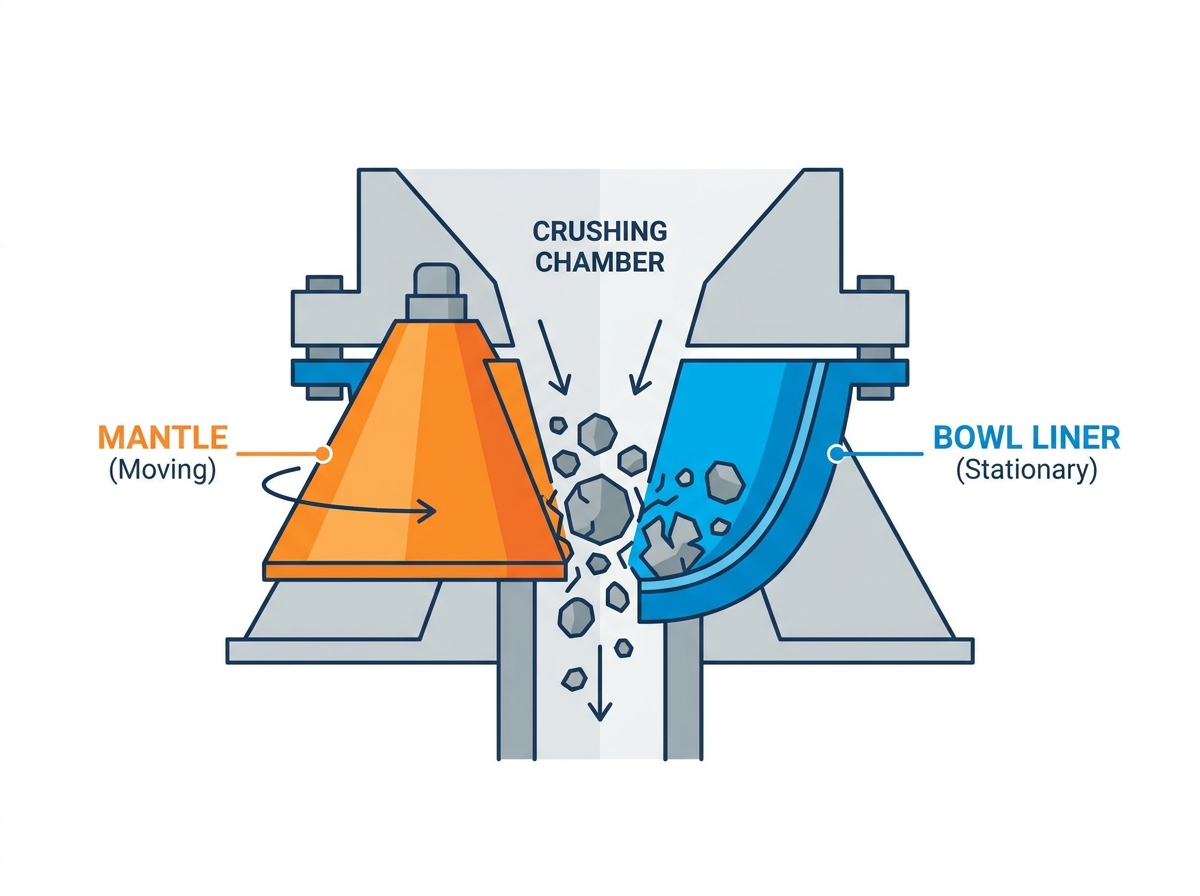
You should never view these components as isolated parts. They form a highly synchronized system. Their spatial relationship dictates your entire production efficiency. When operators change settings blindly, they disrupt this delicate balance. Let us examine how they interact to crush effectively.
The nip angle describes the spatial relationship between the two liners. It dictates the machine's ability to grip feed material. If the angle is too wide, the rock will slip. It will bounce upward instead of breaking. This causes severe energy waste. If the angle is too narrow, the cavity chokes easily. The material cannot flow downward.
Maintaining the correct angle ensures smooth continuous crushing. As rock moves down the chamber, the angle naturally changes. It tightens near the bottom to crush smaller particles. Engineers design these angles meticulously. Installing mismatched profiles ruins this geometry immediately. You must preserve the intended angle to avoid material slippage.
The parallel zone sits at the bottom of the liners. This area defines the choke point. It determines your Closed Side Setting (CSS). The CSS is the smallest distance between the two components during the eccentric cycle. It ultimately dictates your final product size. Accurate CSS calibration is non-negotiable for consistent output.
Material spends the most time in this parallel zone. Therefore, it experiences the highest rate of wear. As the metal wears away, the choke point widens. Operators must adjust the bowl downward to maintain the CSS. Ignoring this adjustment leads to oversized product. It also causes uneven pressure distribution across the lower cavity.
A mismatch in profiles causes severe uneven pressure distribution. When the faces do not align correctly, localized stress points emerge. This leads to dangerous power spikes. The motor draws excessive current trying to force material through an improper gap. You will also experience ring bounce. The upper frame lifts violently under extreme pressure.
Prolonged ring bounce destroys internal bronze bushings. It damages the main shaft and thrust bearings. Mechanical failure becomes inevitable under these conditions. Always ensure your chosen profiles complement each other perfectly. Do not mix coarse and fine profiles on a whim. The resulting damage far outweighs any perceived short-term savings.
Selecting the right metal alloy requires a technical framework. You cannot simply guess which material will perform best. Crusher liners rely on specific metallurgical properties to survive. Understanding these properties separates experienced procurement officers from novices.
Austenitic manganese steel hardens upon impact. This is the work-hardening principle. In its initial state, the metal is relatively soft and ductile. As rocks repeatedly strike the surface, the outer layer compresses. Its microscopic crystal structure changes. The surface becomes incredibly hard while the inner core remains ductile. This combination prevents catastrophic cracking.
Matching the alloy to the rock's impact and abrasion ratio is critical. If your rock is highly abrasive but lightweight, it will not trigger the hardening effect. The metal will simply wear away quickly. You must generate enough impact force to activate the hardening. Otherwise, premium manganese becomes a costly mistake.
Industry standards classify manganese alloys by their percentage content. Choosing the correct grade depends entirely on your feed material and crushing stage. The comparison chart below details standard manganese grades and their ideal applications.
Manganese Grade | Primary Characteristics | Ideal Application Scenarios |
|---|---|---|
Mn14 (14% Mn) | High initial hardness, lower ductility. | Best for highly abrasive, low-impact applications. Ideal for small feed sizes in tertiary crushing. |
Mn18 (18% Mn) | Balanced toughness and wear life. | The industry standard. Offers a reliable mix of impact resistance and longevity across varied geology. |
Mn22 (22% Mn) | Maximum ductility, requires heavy impact. | Ideal for high-impact applications like primary/secondary crushing of very large, hard rock feed sizes. |
Many buyers assume "higher manganese" automatically means "longer life." This is a dangerous misconception. If you install Mn22 in a fine crushing application, it will fail rapidly. The small rocks lack the mass to deliver heavy impact. The metal never work-hardens. It remains soft and wears out prematurely.
Always evaluate your specific geological conditions. Do not let vendors upsell you to Mn22 without proof of heavy impact. Sometimes, the cheaper Mn14 performs significantly better. Base your decisions on actual wear data rather than marketing claims. Match the alloy strictly to the impact force present in your chamber.
Procurement requires strict shortlisting logic based on operational realities. Your choices directly impact production yield. Let us guide you through a proven decision framework for selecting the right castings.
Chamber profiles fall into three main categories: Coarse, Medium, and Fine. Coarse profiles feature a massive intake opening. They handle large primary feed easily. Fine profiles have a narrow top opening. They excel at producing sand or small aggregates. You must match the profile strictly to your feed material size.
Coarse Profiles: Use for secondary crushing where feed rock is exceptionally large.
Medium Profiles: The versatile middle ground. Good for standard aggregate reduction.
Fine Profiles: Mandatory for tertiary circuits demanding strict particle shape control.
The maximum feed size should never exceed the chamber's designed intake opening. Forcing oversized rocks into a fine profile causes immediate bridging. The feed blocks the opening, halting production instantly. Always measure your feed accurately before ordering new profiles.
Buyers often face a difficult compromise. Thicker, heavier liners offer a longer wear life. You change them less frequently. However, extra metal reduces the chamber's internal volumetric capacity. You literally fit less rock inside the machine. This limits your hourly production yield.
You must balance the upfront cost of heavier castings against lost yield. A massive mantle might run for an extra month. But if it drops your production by twenty tons an hour, you lose money. Calculate the value of your finished product. Often, a standard-thickness profile delivers better overall profitability despite requiring faster replacement.
Do not buy critical components from unverified sources. Demand strict quality controls from your suppliers. Use the following criteria to evaluate them.
Dimensional Accuracy Guarantees: Ask for CNC machining reports. If the mating surfaces are uneven, the parts will not seat correctly in the crusher.
Ultrasonic Testing Reports: Castings often hide internal shrinkage cavities. Ultrasonic testing proves the part is free of dangerous internal defects.
Custom Profile Capabilities: Top vendors can modify standard designs. They should offer custom thickness in high-wear zones tailored to your specific rock.
Material Certification: Demand a chemical composition sheet. Verify the manganese and carbon ratios match your order exactly.
Knowing when to schedule maintenance is just as critical as choosing the right parts. Waiting too long invites catastrophic failure. Changing them too early wastes money. Let us address the most common implementation questions regarding maintenance cycles.
The standard industry consensus advocates for concurrent replacement. You should replace both parts simultaneously. This practice maintains the optimal chamber profile. It resets the nip angle to factory specifications. A fresh set guarantees maximum crushing efficiency from day one. You achieve better particle shape and lower power draw.
However, operators sometimes attempt staggered replacements to save budget. They pair a new mantle with a worn bowl liner. Detail the risks before attempting this. It severely alters the nip angle. It reduces your feed intake capacity. The mismatched geometries accelerate wear on the brand-new component. We only recommend staggered changes under strictly monitored conditions with identical wear rates.
Visual inspection provides vital clues about your operation. Teach your crew to spot warning signs during maintenance shutdowns. "Bell-mouthing" occurs when the lower parallel zone wears completely away. The bottom opens up like a bell. This indicates you are running a CSS far too tight for the chamber design.
"Cupping" shows localized deep depressions on the crushing face. This indicates incorrect feed distribution. The material is dropping heavily onto one side of the chamber. Segregated feed causes one side to wear twice as fast. Correcting your feed chute design will eliminate cupping and double your wear life.
Do not base replacement schedules purely on calendar days. Track the physical weight of the castings. A typical liner should be discarded when it has lost 40–50% of its original weight. The remaining metal thickness becomes dangerously thin beyond this point.
Pushing beyond the 50% threshold risks cracking. A broken casting will severely damage the crusher's internal structural components. The main shaft or head can suffer permanent scarring. Weigh your worn parts after removal. Compare this to their brand-new weight. This data helps you predict future maintenance cycles perfectly.
Maximizing the return on your crushing equipment requires treating the internal components as a synchronized system. They are not standalone commodities. Proper interaction dictates your nip angle, production yield, and finished aggregate quality. Ignoring chamber dynamics leads directly to mechanical failure and poor output.
Long-term success relies entirely on tracking reliable wear data. Always measure tons produced against the physical weight lost by the castings. This mathematical approach allows you to continuously refine your profile choices. It also helps you dial in the exact manganese grade required for your geology.
Do not wait for a catastrophic breakdown to evaluate your chamber. Audit your current wear patterns today. Inspect your discarded parts for cupping or bell-mouthing. Consult with a wear parts specialist to evaluate your current configuration and eliminate hidden inefficiencies.
A: Technically yes, but it is highly discouraged. It severely alters the intended crushing profile. This mismatch heavily limits your feed intake and ruins the optimal nip angle. Furthermore, the old geometry creates uneven stress points, which rapidly accelerates wear on the new component.
A: Running a CSS tighter than the chamber’s original design forces excessive localized wear in the lower parallel zone. This leads to premature failure, bell-mouthing, and significantly increased power draw. It can also cause ring bounce, threatening the machine's structural integrity.
A: Wear life is highly variable. They might last only a few days in extreme quartzite, or several months in soft limestone. Focus strictly on "cost-per-ton" rather than raw operating hours. Tracking production volume against weight loss is the only true way to evaluate performance.
