

Views: 0 Author: Site Editor Publish Time: 2026-07-29 Origin: Site


Plant managers and maintenance leads face a constant dilemma every single shift. They must balance strict maintenance budgets against the catastrophic risk of unplanned downtime. You might see the repair versus replace choice as a simple maintenance preference. However, it actually drives your operational cost-per-ton calculation.
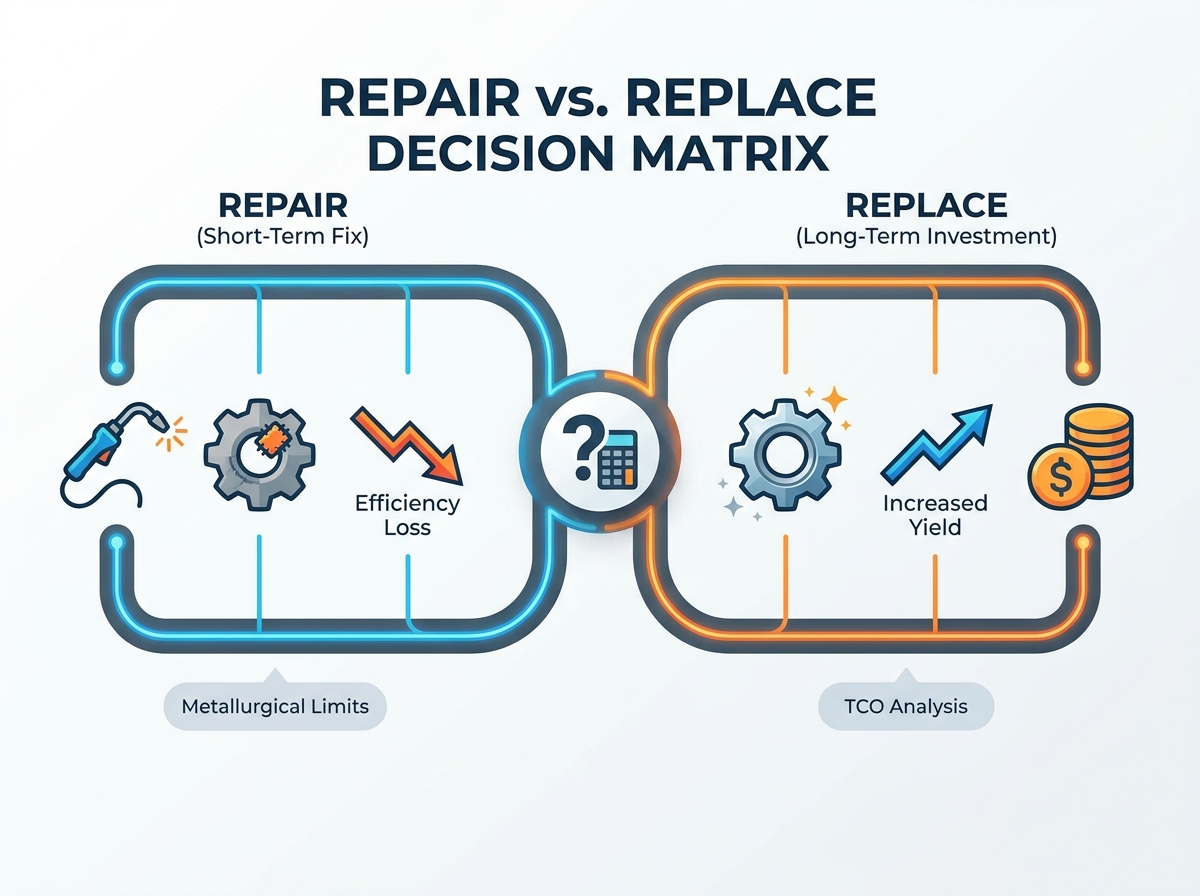
Temporary repairs like hardfacing or welding can extend equipment lifespan for a short period. Yet, pushing components beyond their metallurgical limits degrades product yield and risks total machinery failure. Maintaining worn components artificially limits your production capacity and harms final product quality.
This article provides an evidence-based framework for making these critical operational decisions. We will show you exactly when to stop repairing and initiate a full component replacement. You will learn to identify severe wear signs across different equipment types to maximize plant profitability.
The 50% Rule: If the cost of repairing a wear part (including labor and downtime) exceeds 50% of the replacement cost, replacing is typically the more profitable choice.
Throughput Penalties: Worn parts don't just risk breaking; they immediately reduce crushing efficiency, increasing energy consumption and yielding out-of-spec aggregates.
Metallurgical Limits: Repeated heat cycles from welding/hardfacing alter the structural integrity of manganese and alloy parts, increasing brittleness.
Predictive Sourcing: Proactive replacement audits prevent emergency freight costs and prolonged operational halts.
Maintenance teams often celebrate a successful weld on a cracked mantle. They believe they saved the operation thousands of dollars. In reality, constant patchwork creates an illusion of cost savings. Over-repairing crusher wear parts acts like a hidden tax on your entire aggregate plant. You trade a predictable capital expense for unpredictable operational losses.
Consider the massive difference between scheduled downtime and catastrophic failure. Scheduled replacements are controllable. You can stage parts, assign crews, and time the swap during off-hours. Unplanned mid-shift failures are uncontrollable. A shattered jaw plate can cause cascading damage to the pitman, bearings, and conveyor belts below. This transforms a standard maintenance task into a multi-day operational crisis.
Furthermore, worn profiles drag down your efficiency. Even skillfully patched components lose their optimal crushing geometry. When profiles flatten out, the crusher motor must draw significantly more amperage to achieve the same reduction ratio. You burn more electricity to produce less rock.
Finally, pushing compromised components poses severe safety risks. Operating machinery with weakened structural integrity introduces physical hazards. Flying debris or sudden catastrophic jams threaten personnel safety and violate strict compliance regulations. You must prioritize worker safety over extending part life.
You need concrete parameters to signal the end of a component's lifecycle. Relying on visual guesswork leads to premature replacements or dangerous delays. Look for these four specific evaluation criteria.
The nip angle dictates how effectively a crusher grips and fractures rock. When corrugations flatten, you lose this vital angle. Material begins to slip and boil inside the chamber rather than passing through smoothly. This slippage drastically reduces throughput. Once a liner loses its distinct profile, no amount of hardfacing can restore the original crushing geometry. Replacement becomes mandatory to restore production targets.
Surface scratches are normal. Deep structural fissures are fatal. Over time, surface checks transition into deep-seated micro-cracking. Welding cannot safely penetrate these deep flaws. The weld simply masks a growing void beneath the surface. Using dye penetrant testing can reveal the true depth of these cracks. If the fissure penetrates the core structural zone of the part, you must discard it immediately.
Feed distribution is rarely perfect. Material often favors one side of the crushing chamber, leading to localized washout. These deep wear pockets compromise the overall geometry of the liner or mantle. Even if 80% of the part retains adequate thickness, a single localized thin spot creates a massive structural vulnerability. The part will inevitably crack at its thinnest point under heavy load.
Many operators rely on hardfacing to build up worn areas. However, this ignores a harsh metallurgical reality. Repeated heat cycles from welding create expanding heat-affected zones (HAZ). This intense heat alters the original alloy matrix. It destroys the base metal's impact resistance, leaving the component dangerously brittle. Eventually, the part will shatter under a high-stress impact.
Different machinery profiles require tailored maintenance decisions. You cannot apply a universal rule across all crusher types. Here is how to evaluate specific solution categories.
Jaw crushers rely on intense compression. Reversible wear plates offer excellent value, but they have finite flips. Focus your attention on the tooth profile. Once the teeth wear down flush with the valleys, crushing efficiency drops rapidly. Additionally, monitor the jaw plates for bowing. A bowed plate loses contact with the machine frame. This creates stress concentrations that will eventually crack the casting. Bowing is a strict trigger for immediate replacement.
Impact crushers rely entirely on kinetic energy and rotational balance. Rotor imbalance is the primary enemy of this equipment. Operators sometimes attempt to build up worn hammer faces with weld material. However, uneven wear or weight discrepancies across Hammer Crusher Wear Parts create violent vibrations. These vibrations will quickly destroy expensive drivetrain bearings. You must execute full set replacements to guarantee balanced rotational mass and protect the wider machine.
Cone crushers demand precise tolerances. You must focus closely on mantle and bowl liner thickness. Every manufacturer provides a minimum thickness threshold for their liners. Once wear reaches this physical limit, the backing compound begins to fail. Operating past this threshold makes repair physically impossible and structurally dangerous. The liner will eventually crack and damage the main shaft.
Equipment Type | Primary Wear Component | Critical Replacement Trigger | Repair Viability |
|---|---|---|---|
Jaw Crusher | Jaw Plates (Stationary & Movable) | Loss of tooth profile; structural bowing. | Low. Flipping is standard, welding is discouraged. |
Hammer Crusher | Hammers / Blow Bars | Weight imbalance exceeding 5%; loss of strike face. | Very Low. Requires complete balanced set replacement. |
Cone Crusher | Mantle & Bowl Liner | Reaching OEM minimum thickness limit. | None. Risk of backing compound failure. |
Moving from physical wear signs to financial justification requires clear evaluation dimensions. You must transition away from looking only at the immediate price tag. Instead, evaluate the features-to-outcomes impact on your entire operation.
To effectively run a cost-per-ton analysis, compare the true operational costs. Follow this process:
Calculate the total price of a new part, including freight and installation labor.
Divide that total by the expected tonnage the new part will process.
Calculate the repair cost, including welder labor, consumables, and lost production hours.
Divide the repair cost by the shortened, estimated tonnage of the repaired part.
Almost always, the fresh component yields a lower long-term cost-per-ton. You must also factor in the "increased yield" variable. Fresh components allow you to return to 100% production capacity. They maintain a tighter closed-side setting (CSS). This tight setting delivers better product gradation and reduces the volume of oversized material that requires re-crushing.
Finally, conduct a serious risk assessment. Assign a monetary value to the probability of a patched component failing prematurely. If a welded part breaks during a peak high-demand production run, the financial penalty far exceeds the price of a new casting. Using high-quality Crusher Wear Parts minimizes these operational risks significantly.
Scenario Indicator | Recommended Action | Operational Rationale |
|---|---|---|
Repair cost > 50% of new part | Replace | Economics heavily favor new capital investment over sunk repair costs. |
Loss of primary crushing angle | Replace | Throughput drops rapidly; energy consumption spikes. |
Minor surface abrasion | Monitor / Minor Repair | Normal wear pattern; does not affect structural integrity. |
Rotor weight imbalance detected | Replace Complete Set | Prevents catastrophic main bearing and shaft failure. |
Once you decide to move forward with a replacement strategy, you must manage implementation risks. Poor supply chain execution can ruin your maintenance schedule.
Inventory management and lead times are critical. Relying on "just-in-time" delivery for heavy castings is a massive operational risk. Supply chain disruptions can delay shipments by weeks. Operators must stock critical components on-site ahead of failure. You cannot afford to halt your plant while waiting for a heavy freight delivery.
When shortlisting suppliers, you must evaluate aftermarket versus OEM options carefully. Do not buy on price alone. Base your criteria on metallurgical certifications and dimensional guarantees. The best suppliers use advanced 3D scanning to ensure their aftermarket components fit perfectly. Ask potential partners for documented field trials that prove their alloy formulas perform well under real-world stress.
Lastly, phase your installation intelligently. Plan these heavy replacements during scheduled preventative maintenance (PM) windows. Timing the swap properly minimizes baseline disruption. Aligning wear part replacements with screen media changes or conveyor belt maintenance keeps your overall downtime to an absolute minimum.
Replacing compromised components is a direct investment in plant efficiency and risk mitigation, not just an unavoidable expense.
Waiting for catastrophic failure—or relying on a final, desperate weld—remains the most expensive maintenance strategy you can deploy.
Fresh profiles restore your desired gradation, reduce power draw, and protect surrounding machinery from severe collateral damage.
Call to Action: Schedule a professional wear audit today. Request a detailed cost-per-ton analysis from a qualified supplier, and immediately review your current on-site inventory to secure your replacement components before an emergency strikes.
A: No. Repeated hardfacing induces severe heat fatigue and brittleness in the metal. Over time, the heat-affected zones destroy the base metal's yield strength. The part will eventually shatter under the immense pressure of the crushing chamber, leading to dangerous and costly equipment failures.
A: Yes. Fresh crushing profiles maintain the correct closed-side setting (CSS) and ideal chamber geometry. This ensures proper material flow and compression. It directly impacts product consistency, reduces oversized material, and significantly improves the quality of your final aggregate gradation.
A: Focus on selecting reputable suppliers who utilize advanced 3D scanning technology. You should request stringent quality control documentation and insist on guaranteed dimensional tolerances. Reputable foundries will provide metallurgical certs to prove their parts match or exceed OEM specifications.
A: Always replace them as a complete set or in strictly matched weight groups. Replacing just one or two hammers creates a severe rotor imbalance. This imbalance generates intense vibrations that can quickly destroy the crusher's drivetrain, main shaft, and expensive bearings.
