

Views: 0 Author: Site Editor Publish Time: 2026-07-31 Origin: Site


Crusher downtime and premature wear remain silent killers of quarry profitability. Manufacturers design standard OEM parts for average operational conditions. However, no two quarries operate in exactly average environments. Extreme abrasiveness or unique feed sizes quickly expose standard design limits.
Maintenance superintendents and procurement teams face a critical daily dilemma. They must choose between continuously replacing these standard profiles or investing in custom-engineered solutions. Making the wrong choice drains maintenance budgets and chokes daily production limits.
We provide a transparent, evidence-based evaluation framework below. You will learn how to identify hidden operational bottlenecks and assess rock abrasiveness accurately. We will help you determine if transitioning to custom Crusher Wear Parts makes financial sense for your specific site.
Standard profiles offer predictable availability and baseline performance, ideal for uniform, low-abrasion feed materials.
Custom wear parts deliver ROI primarily in high-abrasion environments or when specific production bottlenecks (e.g., pegging, poor shape) occur.
Total Cost of Ownership (TCO) should dictate the decision, weighing upfront costs against extended wear life, reduced change-out labor, and increased throughput.
Transitioning to custom parts requires a structured pilot phase, baseline wear tracking, and careful alloy selection.
Manufacturers design standard OEM profiles to accommodate very broad applications. They try to fit every basic scenario. This approach often causes major inefficiencies during extreme operations. Foundries cast standard liners using generalized geometries. They do not account for your specific rock hardness. They ignore your unique crushing angles. Operators assume standard parts represent the safest choice. Instead, these generic designs frequently limit optimal crushing performance.
You must recognize when standard components fail your operation. Several clear indicators reveal severe underperformance. Look closely at your scrap pile. Monitor your daily production charts. You will likely spot these distinct failure patterns:
Localized or premature wear zones forming near the crushing chamber exit.
Frequent pegging or blinding occurring inside the crushing chamber.
Unacceptable drop-offs in production rates as the liner wears down over time.
Focus on overall financial health. The true expense never equals just the initial manganese steel price. You must calculate lost revenue from unplanned maintenance shutdowns. You also lose money through decreased crushing efficiency. Every hour spent replacing a worn jaw die halts production entirely. Frequent replacements require expensive crane rentals. They demand intensive manual labor. They expose workers to unnecessary safety hazards. All these factors destroy quarry profitability rapidly.
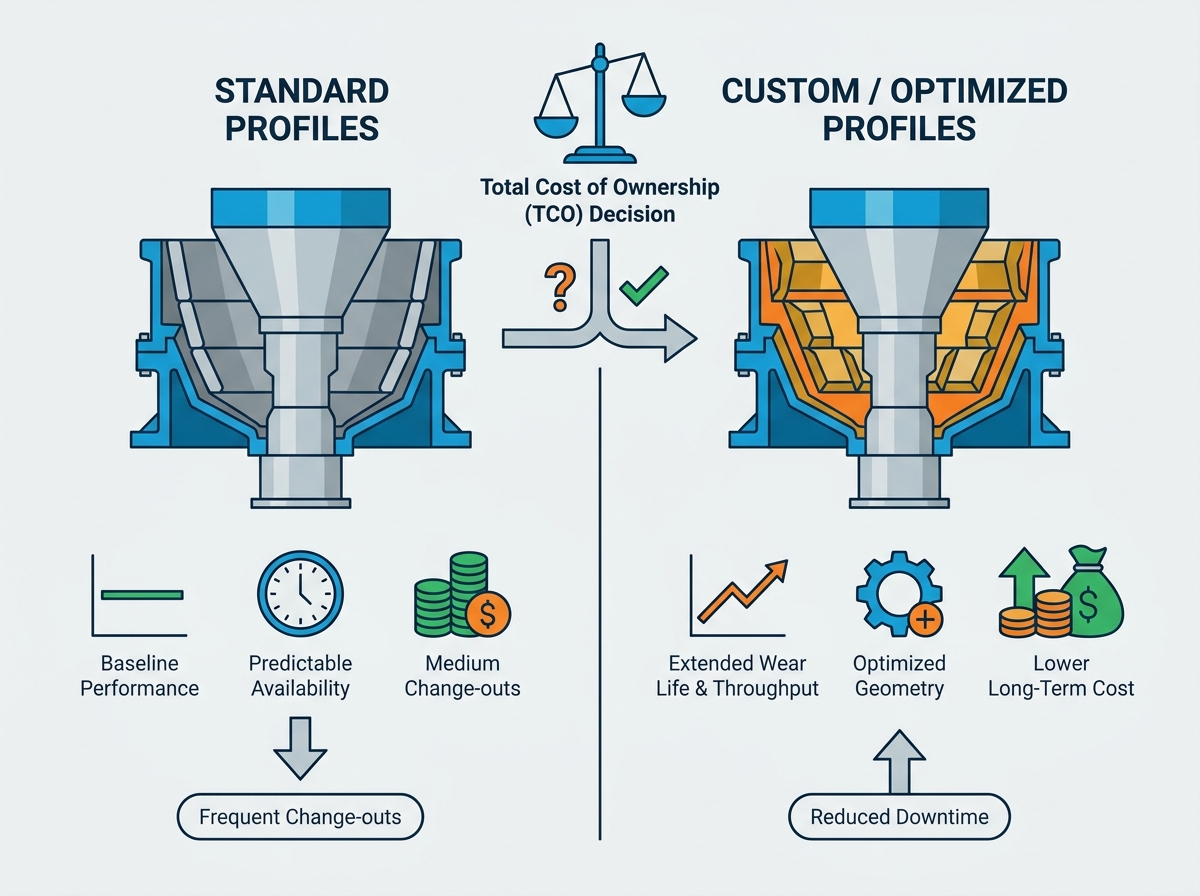
Standard components provide a reliable baseline. Operators appreciate their guaranteed fit. Global suppliers stock them widely. You can predict their basic performance easily. However, they carry significant drawbacks. They feature fixed geometries. They utilize standard metallurgy. Manufacturers typically pour them using standard 14% or 18% manganese steel. This basic composition often fails against unique rock abrasiveness.
Custom engineering changes the entire production dynamic. We adapt the metal to the stone. We do not force the stone through generic metal.
Engineers modify the feed opening directly. They adjust the nip angle for better grip. They reshape the crushing zone completely. These changes match your specific feed sizes. They guarantee your desired output gradation.
Standard alloys often surrender quickly. Foundries counter this by utilizing specialized alloys. They pour 22% manganese for severe impact zones. They embed Titanium Carbide (TiC) inserts directly into the wear face. They apply specialized heat treatments. These upgrades conquer high-impact environments easily.
Custom designs specifically improve critical crushing components. For example, a custom Cone Crusher Mantle and Bowl Liner maintains a consistent closed-side setting much longer. Heavy-duty jaw dies retain their tooth profiles indefinitely. This preserves your daily production capacity.
Below is a chart summarizing these core differences:
Feature Category | Standard OEM Profile | Custom Engineered Profile |
|---|---|---|
Geometry & Fit | Fixed dimensions, guaranteed standard fit | Altered feed openings, custom nip angles |
Metallurgy | Standard 14% to 18% Manganese | 22% Manganese, TiC inserts, custom alloys |
Availability | Widely stocked, fast initial shipping | Requires lead time for patterns and casting |
Performance Focus | Average throughput across all quarries | Maximized throughput for specific site conditions |
You must evaluate your rock accurately. Test the silica content immediately. Measure the exact hardness using the Work Index. Check the moisture level of your feed material. Highly abrasive materials justify custom alloy investments easily. Soft limestone rarely requires titanium carbide inserts. Hard granite demands enhanced metallurgical properties. Match your metal to your geology.
Assess your daily production charts carefully. Watch for dropping tons-per-hour (TPH). Monitor your product shape. Standard liners often produce poor particle shape as they wear down. Flakiness increases rapidly. Custom profiles retain their optimal crushing geometry. They maintain your TPH from installation until removal.
Calculate the human cost of frequent liner change-outs. Maintenance stops pose severe safety risks. Heavy lifting creates physical hazards. Custom parts often double the expected wear life. This improvement halves the safety exposure hours for your maintenance crews. Fewer change-outs mean fewer accidents. Keep your workers safe.
This metric serves as your ultimate decision tool. You must look past the initial invoice price. A custom liner might cost 30% more upfront. Therefore, it must deliver at least a 30% increase in wear life. Alternatively, it must provide a proportional increase in TPH. If it achieves either goal, you break even. If it achieves both, you generate massive new profits.
Many operators fear aftermarket upgrades. They mistakenly believe non-OEM parts void equipment warranties automatically. We must clarify standard industry practices here. Reputable aftermarket components generally comply fully with structural tolerances. Equipment manufacturers cannot legally void a warranty simply because you chose an aftermarket supplier. You should verify specific terms, but do not let fear dictate your procurement.
You must differentiate between true engineering and basic copying. Copycat aftermarket suppliers simply reverse-engineer standard profiles. They offer no genuine improvements. True custom foundries utilize advanced technology. They deploy 3D scanning on your worn parts. They run complex wear simulation software. They create custom patterns specifically for your chamber. Demand advanced engineering.
Weigh your supply chain options carefully. OEM global supply chains often suffer from extreme rigidity. A disruption overseas halts your local production. Specialized casting foundries offer distinct advantages. They provide localized lead times. They adapt flexibly to your changing needs. They can pour emergency replacements much faster than a rigid global network.
You cannot improve unmeasured processes. You must document your current operational metrics before making any switch. Without baseline data, you cannot prove success. Gather the following information first:
Document the exact wear life hours of your current standard liners.
Record your average daily tons-per-hour (TPH) across a full month.
Track the exact frequency of your closed-side setting (CSS) adjustments.
Calculate your current labor hours spent on maintenance change-outs.
Never roll out experimental parts plant-wide. We strongly recommend a focused pilot testing approach. Start with a single machine. Your secondary cone crusher serves as an excellent test bed. Monitor this single machine closely. Prove the concept here first. Once the custom design validates your financial goals, expand the rollout slowly.
Treat your first custom part as a learning tool. Advise your foundry to use 3D laser scanning on your worn standard liners. This technology identifies exact high-wear zones perfectly. The foundry can then thicken those specific areas in the new custom design. Iterate continuously. Your second custom liner will perform even better than the first.
Always protect your daily production quota. Maintain a complete set of standard liners in your local inventory during the pilot phase. Custom profiles sometimes require further refinement after the first pour. Do not risk catastrophic downtime. If the custom part fails early, swap back to the standard part immediately. Keep crushing while the engineers adjust the pattern.
Custom wear solutions are not a blanket necessity for every quarry. Rather, they represent a strategic upgrade for specific production bottlenecks. They shine brightest in highly abrasive conditions.
Apply clear shortlisting logic. If your standard parts last acceptable durations, stick to standard. If your TPH remains stable, avoid unnecessary changes. However, if change-outs occur frequently, reconsider your strategy. If your TPH drops heavily mid-lifecycle, initiate a custom evaluation immediately.
Take proactive steps today. Encourage your team to audit your current cost-per-ton metrics. Contact an application engineer immediately for a thorough chamber wear analysis. Optimize your crushing potential now.
A: Upfront costs are typically higher due to custom pattern creation and specialized alloys. Foundries must invest engineering time into your specific design. However, the ultimate goal is a lower overall cost-per-ton over the part's entire lifecycle. The increased wear life and higher throughput usually offset the initial purchase premium rapidly.
A: Realistic lead times vary by foundry. You must factor in initial 3D scanning, custom pattern creation, casting, and cooling times. Usually, the first iteration takes several weeks to a few months. Once the foundry creates your unique pattern, subsequent orders ship much faster.
A: Using reputable aftermarket wear parts generally does not void warranties. These parts must meet standard structural tolerances to operate safely. Most equipment manufacturers understand this reality. Though legal protections exist, buyers should always verify exact terms with their specific equipment provider before installing new components.
