

Views: 0 Author: Site Editor Publish Time: 2026-07-28 Origin: Site


Procuring the right components carries incredibly high stakes. Premature failure of crusher wear parts inevitably causes unplanned downtime. This operational pause costs facilities exponentially more than the actual replacement components. Hadfield steel, commonly known as manganese steel, remains the dominant material choice to combat this issue. It features a unique "work-hardening" property. This metallurgical trait serves as the true foundation of wear part longevity. Under heavy pressure, the surface hardens significantly while the inner core remains ductile. However, choosing the best grade does not mean simply buying the highest manganese percentage available. Success relies on matching the specific alloy's work-hardening threshold to your feed material's impact and abrasion levels. If you mismatch these variables, even premium grades will fail rapidly. We will explore how different manganese grades react under operational stress. You will learn how to evaluate crushing kinematics and select the exact metallurgical profile your quarry needs.
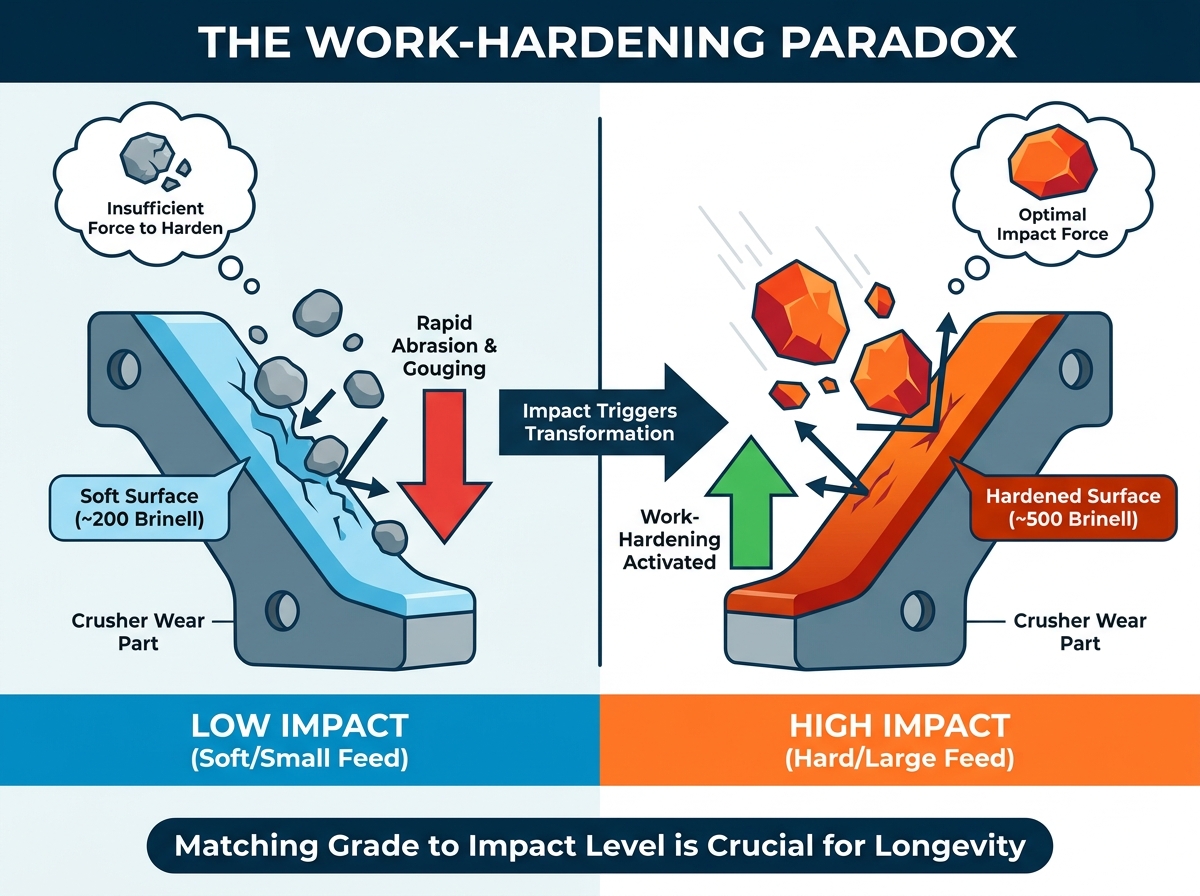
Higher manganese does not mean better wear life: Premium grades like Mn22 will wear out rapidly if the crusher's impact forces are not high enough to trigger work-hardening.
Mn18 is the optimal baseline: For most hard-rock aggregate operations, 18% manganese offers the most reliable balance of ductility and surface hardening.
Application dictates alloy: The choice between grades depends heavily on the specific equipment—requirements for Jaw Crusher Plates and Side Liners differ from cone crusher mantles due to varying crushing kinematics.
Evaluate by cost-per-ton: Sourcing decisions should be based on tracked operational life and tonnage, not initial purchase price.
We must understand the work-hardening paradox to avoid disastrous sourcing decisions. Manganese steel begins its service life relatively soft. Freshly cast parts typically register around 200 Brinell hardness. Severe operational impact forces the crystalline structure to transform. The surface can quickly harden up to roughly 500 Brinell. This mechanism presents a distinct risk. If the impact force is too low, the metal never hardens. The abrasive rock simply gouges the soft steel away.
You also face the distinct cost of over-specifying alloys. Purchasing ultra-high manganese alloys for low-impact applications wastes your maintenance budget. These premium grades require massive force to compress and harden. In smaller or softer feed applications, they wear out faster than cheaper standard grades. Operators often assume a higher initial price tag guarantees longer life. This false assumption leads to rapidly deteriorating internal profiles and lost production hours.
Conversely, you must consider the severe cost of under-specifying. Using standard manganese grades in extreme hard rock environments invites disaster. Large feed sizes generate immense kinetic energy inside the chamber. Standard 11-14% manganese lacks the structural capacity for this intense stress. This mismatch causes structural deformation and severe cracking deep within the casting. Ultimately, you risk catastrophic part failure mid-production. Such failures can damage the expensive internal frame of your machinery.
Foundries generally divide manganese steel into three primary metallurgical categories. We must evaluate these categories based on their operational sweet spots. Proper selection ensures your wear parts match the physical demands of your primary rock type.
Mn14 serves as the original Hadfield steel formula. It works best for soft-to-medium rock environments. You should use it in highly abrasive but low-impact applications. It also handles smaller feed sizes exceptionally well. However, this grade has strict physical limitations. It yields quickly under heavy, repetitive impact. Large, hard boulders easily deform the internal structure. The metal lacks the density needed to resist massive kinetic transfer.
Mn18 represents the most versatile option for aggregate producers. It performs best in standard hard rock quarrying and mixed-feed applications. This grade provides distinct operational advantages. It strikes the most reliable balance between internal toughness and rapid surface hardening. The ductile core prevents severe cracks from propagating. Meanwhile, the outer layer hardens efficiently under moderate-to-high stress. Most sites use Mn18 as their starting benchmark.
Mn22 and Mn24 push the limits of work-hardening potential. They are best for very large feed sizes and extremely hard rock. You will typically use them for processing granite or basalt in primary crushing stages. Consider this crucial implementation warning. These extreme grades must endure constant, massive impact to harden correctly. If your feed size drops, the wear rate will accelerate rapidly. If the rock strata softens, you will lose the work-hardening effect entirely.
Manganese Grade | Ideal Feed Material | Impact Requirement | Primary Risk Factor |
|---|---|---|---|
Mn14 (11-14%) | Soft to medium rock, highly abrasive | Low to moderate | Deformation under heavy impact |
Mn18 (18%) | Standard hard rock, mixed feeds | Moderate to high | General wear if poorly matched |
Mn22/Mn24 (22-24%) | Extremely hard rock (granite, basalt) | Extreme and constant | Rapid wear if impact drops |
The specific component geometry and machine type heavily influence grade selection. Kinematics differ significantly between primary and secondary crushing stages. You must adjust your metallurgy to match how the machine physically breaks the rock.
You must carefully assess the machine's nip angle and feed size. Primary jaw crushers process massive, freshly blasted rock. They subject the fixed and movable plates to sheer, blunt impact force. Because of this violence, you often require Mn18 or Mn22 for the main plates. These premium grades can absorb the initial shock without shattering.
However, the chamber sides face a completely different wear mechanism. They experience much more sliding abrasion than direct impact. You should evaluate if lower manganese suits the side profiles better. Using well-matched Jaw Crusher Plates and Side Liners prevents premature thinning. Alternative alloys might even outperform standard manganese on the cheek plates. The key is understanding the directional flow of the material.
Cone crushers rely on continuous, high-pressure compression. We must emphasize the absolute necessity of "choke feeding" these machines. Choke feeding ensures continuous rock-on-rock crushing. It maintains the consistent, heavy pressure required for optimal work-hardening. Running an empty or half-full cone crusher prevents the manganese from reaching its peak hardness.
Profile retention over time is critical for cone liners. Different grades hold their original cavity shape differently. High-impact operations might force Mn14 out of shape before it wears away. Rather than blindly upgrading to Mn22, analyze the wear pattern carefully. Sometimes you need to change the physical cavity design instead of just increasing the alloy grade.
Procurement and operations managers need an evidence-based decision framework. Relying on guesswork drastically inflates maintenance budgets. We recommend following a structured approach to shortlist the correct alloy for your specific site.
Feed Material Assessment: Analyze the compressive strength of your specific rock. This measures the crushability. Next, determine the silica content to gauge the abrasiveness. High silica usually demands better surface hardness over extreme ductility.
Impact-to-Abrasion Ratio: Determine the primary wear mechanism inside the chamber. Does the rock gouge the metal? If so, you need impact toughness. Does the material cause sliding abrasion? If so, you need rapid surface hardness.
Foundry Quality and Heat Treatment: The chemical composition represents only half the equation. Poor heat treatment will completely ruin even the best Mn22 alloy. Improper water quenching processes leave the metal brittle. You must verify the foundry's quality control standards before ordering Crusher Wear Parts.
Cost-Per-Ton Tracking: Establish a rigid pilot testing protocol. Track the wear life of any new grade against total tonnage produced. Always factor in the cost of downtime for changeouts. Never judge a liner solely by its initial purchase price.
Upgrading your metallurgy introduces new variables to the maintenance team. You must manage several critical implementation risks to succeed. Even the perfect alloy will fail if installed improperly or run under incorrect conditions.
Fitment and Backing Compounds: A harder, higher-grade manganese liner acts differently during installation. It is highly susceptible to cracking if not seated correctly. You must support the part using high-quality epoxy backing compound. Voids behind the liner will cause catastrophic failure.
The "Break-In" Period: You must manage operator expectations regarding initial wear. Manganese steel wears rapidly during the first few shifts. The work-hardening layer takes time and pressure to fully form. Do not panic if early measurements look poor.
When Manganese is the Wrong Choice: Recognize scenarios where manganese fails entirely. You should avoid it in highly abrasive, zero-impact environments. In these specific cases, High-Chrome iron or ceramic inserts prove vastly superior. Manganese simply cannot harden without kinetic energy.
The "best" manganese grade is inherently tied to your specific crushing environment. It relies entirely on operational variables and feed material characteristics. There is no universal solution for every quarry. We recommend starting with a high-quality Mn18 baseline. From there, adjust up to Mn22 or down to Mn14. Base this adjustment purely on documented wear profiles and cost-per-ton data. Always let field evidence guide your procurement choices.
We highly encourage consulting with a reputable foundry or wear part engineer. Ask them to audit your current wear patterns before you place an order. Review their heat-treatment specifications to ensure metallurgical integrity. By taking these proactive steps, you guarantee maximum uptime and optimal crushing efficiency.
A: Yes, you can mix grades depending on the component's function. Stationary parts often face different forces than moving parts. You might use Mn22 on a moving jaw plate for extreme impact. Meanwhile, you could use a standard grade or alternative alloy on the stationary side liners to combat sliding abrasion.
A: Premium Mn22 requires constant, massive impact to trigger its work-hardening properties. If your rock is too soft or your feed size is too small, the metal remains in its ductile state. Abrasive rock will quickly gouge the unhardened surface away. You simply lack the kinetic energy needed for this grade.
A: Yes, micro-alloying provides specific benefits. Adding 1-2% Chromium or Molybdenum increases the initial yield strength of the steel. It also provides a slightly higher baseline hardness before work-hardening begins. This helps resist initial wear during the break-in period and maintains the liner's profile longer in highly abrasive applications.
A: You must track operational metrics carefully. A loss of continuous throughput usually indicates severe profile degradation. You should also monitor physical thickness minimums specified by the equipment manufacturer. Pushing a part too far risks cracking the liner. This can severely damage the expensive internal frame of the machine itself.
