

Views: 0 Author: Site Editor Publish Time: 2026-07-28 Origin: Site


Plant managers constantly battle escalating costs from premature equipment wear. Unplanned downtime consistently threatens daily production targets and strains maintenance budgets. Many operations mistakenly blame the metal itself when their liners fail early. However, the root cause frequently lies in how you feed the machine. Inefficient feeding causes localized stress, destroying viable components prematurely. You need a procedural solution. Choke feeding provides exactly that. Maintaining a consistently full crushing cavity stands as a proven operational standard to maximize equipment lifespan. While premium metallurgy certainly matters, pairing high-quality components with optimized feeding practices proves essential. It is the only verifiable way to achieve maximum return on investment and minimize your cost-per-ton. In this guide, we will explore the exact mechanics behind autogenous crushing. You will discover how choke feeding distributes abrasive friction evenly. Finally, we will detail how to evaluate your current setup and implement lasting, profitable improvements.
Choke feeding promotes rock-on-rock (autogenous) crushing, transferring abrasive friction away from the metal liners and onto the material itself.
Trickle feeding causes localized wear (cupping or grooving), forcing early replacement of otherwise viable wear parts.
Optimizing the feed requires specific site infrastructure, including surge bins, automated sensors, and variable frequency drives (VFDs).
Even with perfect feeding, selecting the correct manganese alloy profile for your specific application dictates baseline wear life.
Defining the baseline helps operators understand their current losses. Trickle feeding means starvation. The machine processes small, intermittent material batches. Operators often mistakenly think this reduces machine stress. They are entirely wrong. Low-volume feeding destroys your liners rapidly. We must contrast this approach against choke feeding. A choke-fed cavity remains constantly full. Material buries the crushing head completely during operation. This full-cavity status represents the optimal baseline. It dictates how the equipment was engineered to run.
The financial impact of trickle feeding cascades through an operation. Lower throughput hurts revenue immediately. Poor feed management also degrades particle shape. It produces excessive flakiness in the final product. Flaky rock requires more reprocessing later. Most importantly, trickle feeding accelerates uneven liner wear. Localized friction grinds away the manganese steel prematurely. You end up throwing away heavy, unused sections of metal. This waste ruins your operational budget over time.
We must frame this decision around cost-per-ton metrics. Optimizing your feed is not just a basic maintenance chore. It represents a critical lever for operational profitability. Every wasted millimeter of manganese eats your profit margins. Replacing liners early incurs heavy labor costs. Unplanned shutdowns halt entire production circuits. Therefore, feed optimization directly controls your financial success. You cannot achieve a competitive cost-per-ton using intermittent feed patterns.
Autogenous crushing action explains why a full cavity works so effectively. "Autogenous" simply means rock crushing rock. A full cavity forces stones tightly together. As the mantle gyrates, internal pressure builds massively. The rocks compress against one another continuously. They fracture before they even touch the steel. This action shields your expensive metal components. The abrasive friction transfers away from the liners. The material itself absorbs the most destructive forces.
Maintaining a constant head of material ensures even wear utilization. The crushing force spreads across the entire working surface. No single zone takes excessive punishment. Even wear patterns keep the machine running smoothly. Unbalanced forces cause severe mechanical vibration. By filling the cavity, you distribute these forces harmoniously. The equipment utilizes the entire liner profile as intended.
Work-hardening realization depends entirely on feed pressure. Manganese steel components possess unique metallurgical properties. They require heavy, consistent impact to harden properly. Trickle feeding provides insufficient impact. The metal remains relatively soft and wears away quickly. Choke feeding delivers consistent, high-pressure strikes. This heavy impact pushes the metal into its maximum wear-resistant state. The molecular structure transforms under pressure. It becomes exceptionally tough on the surface while remaining ductile underneath.
To fully understand the mechanics, consider these critical operational principles:
Consistent Pressure Generation: A full cavity generates the required hydrostatic-like pressure for rock fracture.
Friction Redirection: Kinetic energy dissipates into the rock mass rather than tearing into the steel surface.
Metallurgical Activation: Continuous high impact triggers the transformation from austenite to martensite in manganese steel.
Vibration Dampening: A steady material head acts as a shock absorber for the eccentric shaft.
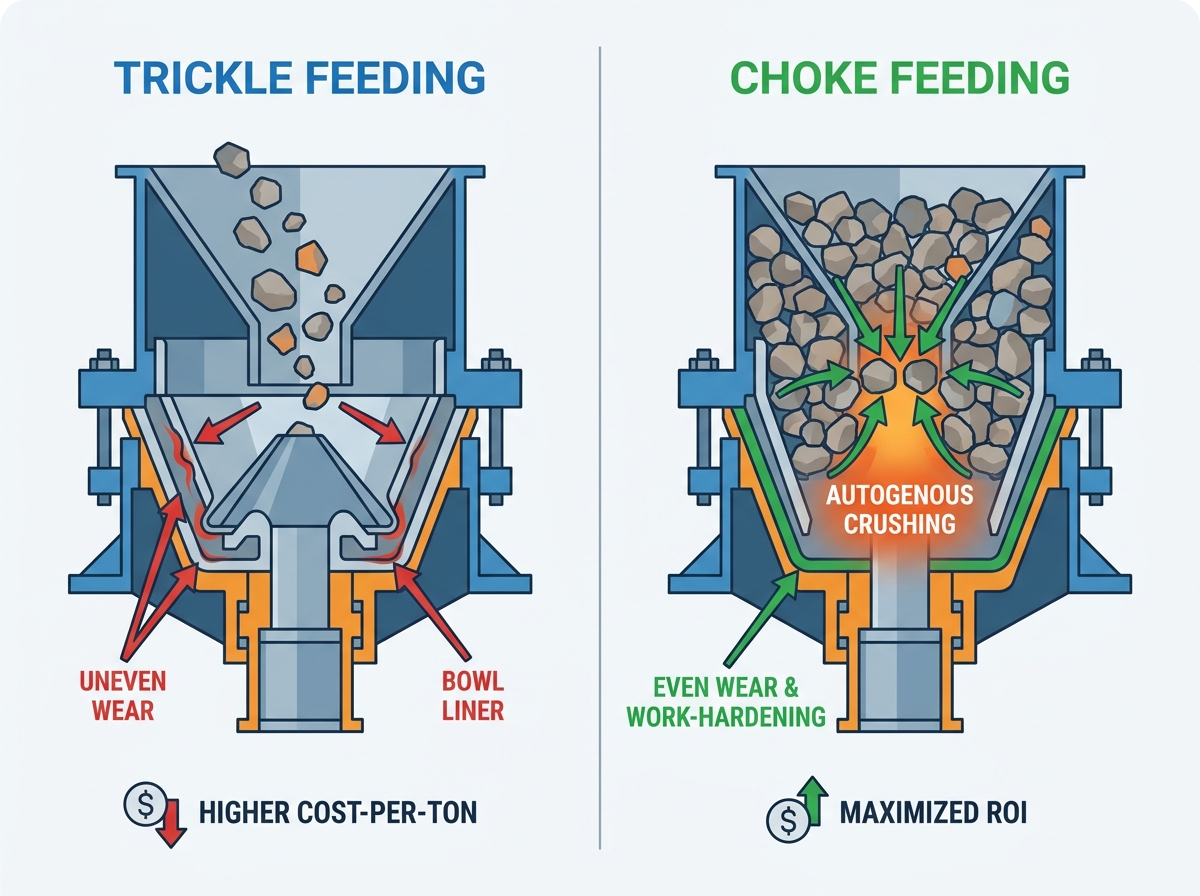
Continuous choke feeding prevents localized grooving. Trickle feeding allows rocks to bounce around loosely. This bouncing creates a severe "wear path" low in the cavity. We call this phenomenon cupping. It typically ruins a Cone Crusher Mantle and Bowl Liner prematurely. When a deep groove forms, you lose crushing efficiency immediately. By maintaining a full feed, you prevent these isolated wear paths. The liners wear down evenly from top to bottom.
Maintaining the nip angle is crucial for consistent performance. The nip angle is the designed gap profile between the liners. It dictates how the machine grabs and crushes the rock. Even wear preserves this specific angle much longer. A stable nip angle ensures consistent product sizing. It reduces your recirculation loads significantly. When the angle degrades, flat rocks slip through uncrushed. This sends oversized material back through the circuit, wasting energy.
Utilization rates improve drastically when wear patterns remain even. We measure this through scrap weight percentages. A poorly fed machine discards heavily uneven scrap. You might throw away liners that are still 60% thick in places. Choke feeding allows you to safely wear down the manganese further. You can achieve a much thinner final profile. You utilize a higher percentage of the metal before a change-out becomes structurally necessary. This efficiency drives your cost-per-ton down considerably.
Optimizing your feed requires specific infrastructure investments. You cannot guess cavity levels manually. True choke feeding demands automated equipment. Surge bins are necessary to store material steadily before it enters the chamber. They provide a buffer against upstream fluctuations. Ultrasonic or radar level sensors monitor the exact cavity depth. Continuous weigh scales track your precise tonnage. Variable frequency drives (VFDs) automatically adjust the conveyor belt speeds based on sensor feedback.
Operators must carefully acknowledge upstream bottlenecks. True choke feeding requires a highly reliable primary circuit. The primary jaw must supply the secondary circuits without stalling. If your primary stage underperforms, the secondary cone will starve. You must balance the entire plant's throughput. Implementing advanced feed controls on one machine achieves nothing if the upstream supply is broken. System-wide synchronization is the ultimate goal.
You must also recognize scenarios where choke feeding fails. Sometimes, this practice becomes inappropriate or highly risky. Excessive fines in the feed cause severe packing. High moisture content leads to material pancaking inside the chamber. Improperly sized tramp iron causes catastrophic mechanical damage. When these conditions exist, a full cavity multiplies the danger. You must screen out sticky fines before they enter the crushing zone.
The following chart illustrates the stark differences between feed strategies across various operational conditions:
Operational Condition | Trickle Feeding Impact | Choke Feeding Impact |
|---|---|---|
Liner Surface Wear | Deep localized grooving (cupping). | Smooth, even wear across the profile. |
Particle Shape Quality | High percentage of flaky, elongated stones. | Excellent cubical shape suitable for concrete. |
Manganese Hardening | Poor. Metal remains soft and wears fast. | Optimal. Metal work-hardens to maximum rating. |
Scrap Metal Waste | High. Discarding thick, unused sections. | Low. Utilizing maximum usable metal volume. |
Energy Efficiency | Poor. Power wasted on idle mechanical rotation. | High. Maximum power transfers into breaking rock. |
Assessing current wear profiles forms your baseline audit. Guide your maintenance team to inspect discarded liners closely. Look for specific failure indicators. Are the liners deeply cupped? Is there excessive scrap weight remaining? Do you see cracks near the mantle base? These symptoms confirm poor feed conditions. Documenting these physical traits helps you calculate exactly how much money you lose annually. It justifies the investment in automated feed controls.
Matching metallurgy to the process remains a necessary foundation. Choke feeding extends life, but metallurgy dictates the starting potential. You must select the right alloy for your specific rock. Popular choices include 14%, 18%, or 22% manganese alloys. Carbon ratios also require precise tuning based on rock abrasiveness. Higher manganese handles extreme impact better. Higher carbon improves resistance to sliding abrasion. Integrating these optimized alloys with better feeding practices maximizes your crusher wear parts longevity.
Your vendor evaluation criteria must evolve past simple pricing. Never select a wear parts supplier based solely on the lowest upfront cost. Look for partners who offer custom cavity design capabilities. Insist on precise machining tolerances for perfect seating. Ask for proven field-testing data from similar quarries. High-quality Crusher Wear Parts should perfectly match your updated feed strategy. A true partner will analyze your scrap and recommend geometric adjustments to the casting.
When selecting your next set of liners, consider these best practices:
Avoid buying off-the-shelf profiles if your feed material is exceptionally abrasive.
Request a cavity scan to model the exact wear path of your current setup.
Ensure the backing compound is correctly applied to prevent mantle seating failure.
Verify the exact manganese and carbon percentages via material test reports (MTRs).
Track the tonnage processed on each set to calculate true operational ROI objectively.
Combining choke feeding with premium wear parts yields exponential improvements in plant uptime. It is not a linear gain. Optimizing your feed protects the metal, improves rock shape, and slashes energy waste simultaneously. When you align your mechanical operations with the correct metallurgy, your profitability transforms. You stop fighting constant maintenance emergencies. Instead, you build a predictable, highly efficient production schedule.
Take proactive next steps immediately. Recommend conducting a detailed cavity profile audit this month. Consult with a wear parts specialist to analyze your current scrap metal graveyard. Redesign your liners specifically tailored to your site's actual feed conditions. Install radar sensors if you currently rely on visual operator guesses. By making these calculated adjustments, you secure a commanding advantage over operational costs.
A: Overfeeding pushes the machine beyond its mechanical limits. Material will spill over the feed hopper, damaging external components. More dangerously, it risks severe ring bounce in cone crushers. This happens when uncrushable material forces the adjustment ring to lift violently. You must use automated level sensors to prevent structural damage. Sensors ensure the cavity stays full without overflowing.
A: It works for both, but the rules differ. It is absolutely essential for cones to maintain particle shape and liner life. For jaws, choke feeding is highly beneficial for output. However, it requires careful management of fines. If excessive fines enter a choke-fed jaw, the material bridges and stalls the machine. Scalping screens must remove fines first.
A: You can realistically expect a 15-30% improvement in component lifespan. The exact number depends on the baseline severity of your previous trickle feeding habits. If your previous feed was extremely poor, the improvement appears dramatic. Autogenous crushing and better work-hardening combine to protect the metal, pushing change-out intervals significantly further down the calendar.
A: Yes, provided they meet strict quality standards. High-quality aftermarket parts with verified metallurgy perform identically to, or better than, OEM components. The key is ensuring precise fitment and matching the alloy to your application. Custom aftermarket profiles can actually handle choke feeding better if they are specifically engineered for your quarry's unique rock abrasiveness.
