

Views: 0 Author: Site Editor Publish Time: 2026-07-29 Origin: Site


Uneven wear is rarely just a minor maintenance nuisance. It serves as a primary driver of unscheduled downtime. Operators often see increased cost-per-ton and lost aggregate yield. Why does this happen? Uneven wear usually indicates a severe misalignment. This misalignment happens between your crushing equipment, your operational setup, and your processed material. You must address it early. Otherwise, you risk compounding mechanical failures. Premature replacements drain operational budgets quickly. You can reclaim this lost profitability through better diagnostics. This guide will help you uncover the root causes of uneven wear. We will objectively evaluate replacement options for your machinery. You will also learn how to implement corrective operational strategies. By understanding these dynamics, you can extend equipment life significantly. Let us explore how you can stabilize production and protect your bottom line.
Root Causes: Uneven wear is most commonly driven by poor feed distribution, incorrect Closed Side Settings (CSS), and mismatched metallurgy.
Financial Impact: Uncorrected wear patterns lead to severe secondary damage, including structural frame fatigue and abnormal crusher vibrations.
Evaluation Criteria: Upgrading crusher wear parts requires matching the alloy (e.g., 18% vs. 22% Manganese) and chamber profile to specific site conditions.
Strategic Fixes: Proper installation, including disciplined flipping schedules and correct backing compound application, is as critical as the part's material quality.
When you ignore wear patterns, you pay a steep price. Compromised crushing chambers choke feed intake quickly. This restriction creates severe production bottlenecks. You will see tons-per-hour (TPH) drop sharply as cavities lose their optimal shape. Reduced throughput immediately impacts your daily revenue targets.
Worn profiles spike internal friction during crushing cycles. Increased friction demands much more electrical power. Your energy bills will rise as efficiency plummets. We see power draw increase by up to 20% in badly worn chambers.
Worn parts also unbalance internal loads dynamically. These unbalanced loads transfer abnormal vibrations throughout the machine frame. Premature failure often strikes bearings, shafts, and bushings next. You must protect these expensive secondary components. Replacing parts too early drastically inflates operational expenditure (OPEX). Every early replacement cuts directly into your profit margin.
First, chamber profiles lose their original nip angle.
Next, the crusher struggles to grab incoming rock, causing slippage.
Slippage generates immense friction and localized heat.
Heat and friction transfer heavy shock loads into the eccentric shaft.
Finally, bearings fail prematurely due to constant unbalanced stress.
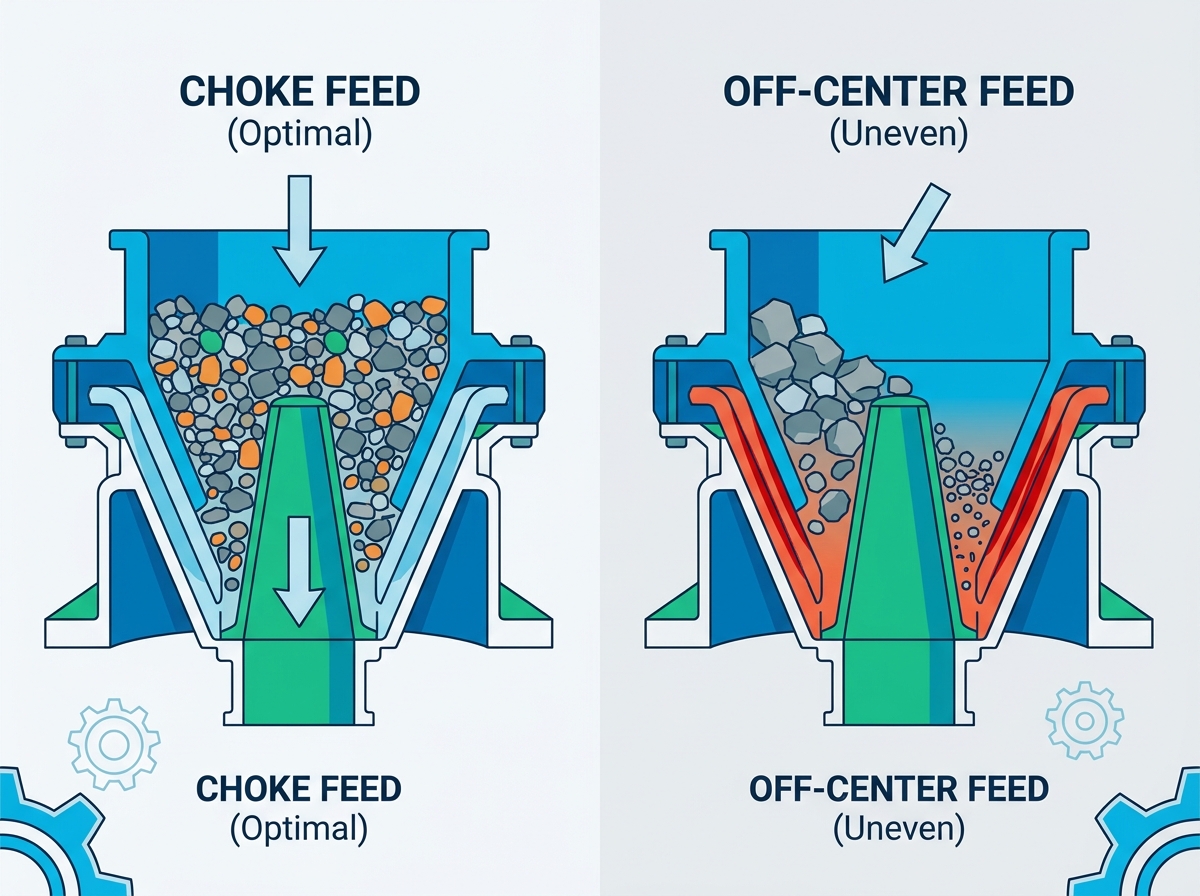
Poor feed distribution ruins parts rapidly. Off-center feeding sends large rocks to one side of the chamber. Fines dump onto the opposite side simultaneously. This imbalance destroys manganese steel prematurely. One side works too hard while the other does nothing.
Trickle feeding is just as damaging to your equipment. It prevents the chamber from achieving a healthy "choke feed" status. Without choke feeding, rock-on-rock crushing fails completely. Localized grooving will develop fast across the liner faces. Your parts will wear out in narrow vertical strips.
Incorrect Closed Side Settings (CSS) also cause severe trouble. Running a CSS too tight creates concentrated pressure zones. This accelerates wear dangerously near the nip angle. Operators often tighten the CSS to compensate for worn parts. This reaction only makes the wear profile worse. It pushes the crushing zone too low in the chamber.
Material abrasiveness strips surfaces relentlessly. High silica content acts like aggressive sandpaper on metal. Fluctuating silica levels make wear prediction very difficult. Uncrushable materials, like tramp iron, cause catastrophic impacts. They destroy the work-hardening layers of manganese steel instantly. Always ensure your crusher wear parts match the actual rock hardness you process daily.
Look closely at your machines during maintenance shutdowns. Jaw Crusher Plates and Side Liners show specific damage signs. Bellying, or mid-plate hollowing, usually means poor feed size matching. It happens when oversized rocks constantly hit the middle zone. Toe wear happens at the bottom of the stationary jaw. It wears faster under massive terminal crushing forces. Proper wedge retention prevents catastrophic toe failure. If wedges loosen, the plate shifts and wears erratically.
Cone crusher mantles and bowl liners wear differently. Lower parallel zone wear indicates a tight CSS. It can also mean too many fines enter your feed. Upper chamber wear points directly to off-center feeding. Oversized rock can also cause upper wear profiles to dish out prematurely.
Impact crusher blow bars round off unevenly. Uneven edge rounding links directly to rotor imbalance. Uneven feed curtains also trigger this issue. You must align curtains correctly to distribute impact forces across the entire rotor.
Wear Pattern Diagnostic Chart
Crusher Type | Component | Visual Wear Pattern | Probable Cause |
|---|---|---|---|
Jaw Crusher | Fixed Plate | Severe Bellying (Cupping) | Oversized feed material hitting the mid-zone. |
Jaw Crusher | Swing Plate | Extreme Toe Wear | Incorrect CSS or loose retention wedges. |
Cone Crusher | Mantle | Upper Chamber Grooving | Off-center feeding or feed segregation. |
Cone Crusher | Bowl Liner | Lower Parallel Zone Thinning | Excessive fines in the feed or CSS too tight. |
Impact Crusher | Blow Bars | Uneven Edge Rounding | Rotor imbalance or misaligned feed curtains. |
Matching metallurgy to your application is vital. Standard manganese steel works well for most impact-heavy jobs. It hardens as rocks strike its surface repeatedly. This work-hardening capability makes it highly popular. For instance, upgrading from 18% to 22% manganese offers better impact resistance. However, it requires massive impact force to harden properly.
Titanium carbide inserts provide extra life in highly abrasive rock. Manufacturers cast these hard inserts directly into the parent metal. They resist sliding abrasion exceptionally well. High-chrome suits impact crushers handling less abrasive, smaller material. Chrome shatters under heavy impact, so use it carefully.
Remember this trust marker: premium alloys are never universal fixes. They will fail if you ignore underlying feed problems. A harder alloy simply wears out unevenly at a slightly slower pace.
Sometimes, you need a custom profile redesign. Standard OEM profiles might not fit your specific quarry conditions. Custom OEM-compatible parts offer thicker zones in high-friction areas. They solve localized wear better than standard replacements. If you constantly suffer from bellying, a thicker mid-section helps significantly.
Vetting supplier authoritativeness guarantees long-term quality. Demand verifiable dimensional accuracy before accepting any shipment. Look for ISO-certified foundry processes to ensure consistency. Request transparent cooling and heat-treatment data from the manufacturer. Proper heat treatment prevents brittle parts from shattering under heavy load. Your new Crusher Wear Parts must undergo strict metallurgical quality assurance.
Installation holds massive execution risks. This is the execution gap many quarries ignore entirely. Improper backing compound pouring ruins great parts. Pouring too cold creates dangerous unseen voids. Voids cause parts to flex and crack under heavy pressure. Torque specifications matter immensely during installation. Loose wedges or bolts cause micro-movements. These movements destroy the seating surfaces rapidly.
Set up disciplined part rotation and flipping schedules. Monitor wear life constantly using ultrasonic thickness gauges. These tools bounce sound waves through the metal. They give you exact thickness readings without removing the part. Flip jaw dies when they reach exactly 50% wear. This practice ensures even utilization and longer overall life. Never wait until the corrugations disappear completely. Once corrugations vanish, crushing efficiency drops to zero.
Condition monitoring prevents unexpected disasters. Establish a baseline vibration analysis for every machine. Modern sensors detect bearing wear months before failure. Conduct daily visual inspections of discharge product shapes. Flaky products usually indicate severe internal wear. The chamber can no longer break rocks cleanly. Catch these uneven patterns before structural damage occurs.
Clean all mounting surfaces thoroughly before installing new liners.
Mix backing compound at the exact temperature specified by the manufacturer.
Re-torque all bolts after the first 8 hours of initial crushing.
Keep a daily log of CSS adjustments to track liner degradation.
Audit your currently worn parts before doing anything else. Pull and photograph them before ordering identical replacements. Clean the worn plates thoroughly first. Give these clear photos to your application engineers. They can analyze the exact wear profile visually. They will spot bellying or grooving immediately.
Assess the cost-per-hour of your active crushing life. Stop looking only at the initial purchase price. Cheap liners often cost much more in unplanned downtime. You must calculate how many tons each part processes successfully. Divide the total part cost by the tons produced. Evaluate the overall operating lifespan to make better financial decisions. Do not repeat past purchasing mistakes just to save budget upfront.
Schedule a thorough supplier consultation immediately. Hand them specific data points to get real answers. Provide feed material specs and current TPH goals. Share your current CSS and wear pattern photographs. Tell them about your uncrushable material events. This precise data guarantees an accurate metallurgical recommendation.
Uneven wear signals a much larger systemic issue. It usually involves poor feed, bad machine settings, or incorrect part selection. You must step away from repetitive "like-for-like" replacements. If wear remains uneven, identical parts will just fail again.
We strongly urge operators to consult a wear parts specialist. Re-engineer your crushing solution to fit your real site conditions. Proactive adjustments save money and protect your heavy equipment. Use the diagnostic tools we shared. Secure better supplier data. Implement disciplined maintenance routines today.
A: Yes. Uneven wear alters the center of gravity and crushing dynamics. It sends unbalanced shockwaves through the machine. These shockwaves manifest as severe vibrations. They directly threaten bearings and structural integrity over time.
A: Industry standard recommends flipping jaw plates when the lower portion reaches roughly 50% of its total wear life. However, this varies based on rock abrasiveness and feed consistency. Regular thickness checks help determine the exact moment.
A: Not necessarily. Harder alloys resist abrasion better. But if off-center feeding or an incorrect chamber profile causes the uneven wear, the new alloy will simply wear unevenly at a slightly slower rate.
A: Look for a significant drop in production capacity. Watch for an increase in oversized or flaky product. Check for visible localized grooving on the liners. Also, note any inability to maintain the desired Closed Side Setting (CSS).
