
+86-13205638142

Views: 0 Author: Site Editor Publish Time: 2026-08-31 Origin: Site


Unplanned downtime in wet classification circuits significantly impacts overall plant throughput. Mineral processing facilities rely heavily on these systems. They separate ore particles efficiently for downstream processing. Slurry abrasion inevitably degrades spiral classifiers over continuous operation. Unpredictable wear cycles quickly lead to inefficient classification. They cause increased circulating loads and force costly emergency shutdowns. You lose valuable production time when critical equipment fails prematurely. We designed this comprehensive guide to help maintenance and procurement teams tackle this challenge. You will learn to evaluate specific wear patterns on your machinery. We provide a practical framework to assess material alternatives for high-quality mining wear parts. You will discover actionable steps to transition your operations toward a highly predictable maintenance schedule. Proactive component management directly improves your operational stability and profitability.
Continuous sliding abrasion directly compromises the geometric tolerance of spiral classifier wear blades, reducing classification efficiency and increasing pump wear downstream.
Material selection (Polyurethane vs. High-Chrome/Ni-Hard) must be dictated by the specific slurry characteristics (pH, particle size, sharpness) rather than upfront unit cost.
Evaluating replacement parts based on Total Cost of Ownership (TCO)—factoring in labor, downtime, and operational efficiency—yields a more accurate ROI than direct part-to-part price comparisons.
Standardized monitoring and proper installation protocols are critical to maximizing the operational life of any wear part upgrade.
Submerged classifier components operate in extremely harsh conditions. They endure continuous sliding abrasion during daily operation. Particles scrape against metallic surfaces constantly. Low-angle impact forces strike the blades as they rotate. These forces slowly remove material from the equipment surface. We see this mechanical degradation across all mineral processing plants. Abrasive friction acts like sandpaper against the metal components. It grinds away the protective layers millimetre by millimetre. Over time, this friction destroys the structural integrity of the parts.
Chemical degradation accelerates mechanical wear significantly. Low pH slurry creates a highly corrosive environment. It continuously strips away passivated protective layers on metallic components. This exposes fresh metal to further abrasive attacks. We call this the corrosion-abrasion synergy. It destroys standard parts faster than mechanical friction alone. Acidic water attacks the grain boundaries of the steel. The weakened surface then yields easily to sliding particles. You must account for both chemical and mechanical forces. They work together to shorten component lifespans drastically.
Several operational variables dictate abrasion severity in your circuit. Spiral RPM directly influences the friction rate. Higher speeds generate more aggressive contact forces. Pool depth alters how particles settle and interact. Slurry density changes the abrasive concentration pressing against surfaces. Particle sharpness determines the cutting action on the blade material. Highly angular quartz particles cut metal faster than rounded river sand. You need to adjust your maintenance expectations based on these variables. Each plant has a unique operating environment. You cannot copy a maintenance schedule from another facility directly.
Hydrodynamic drag forces push against the rising sand bed. The spiral must overcome this resistance continuously. When slurry flows backward, it creates microscopic turbulence. This turbulence lifts fine particles and slams them against the metal. Understanding these mechanics helps you choose better replacement strategies.
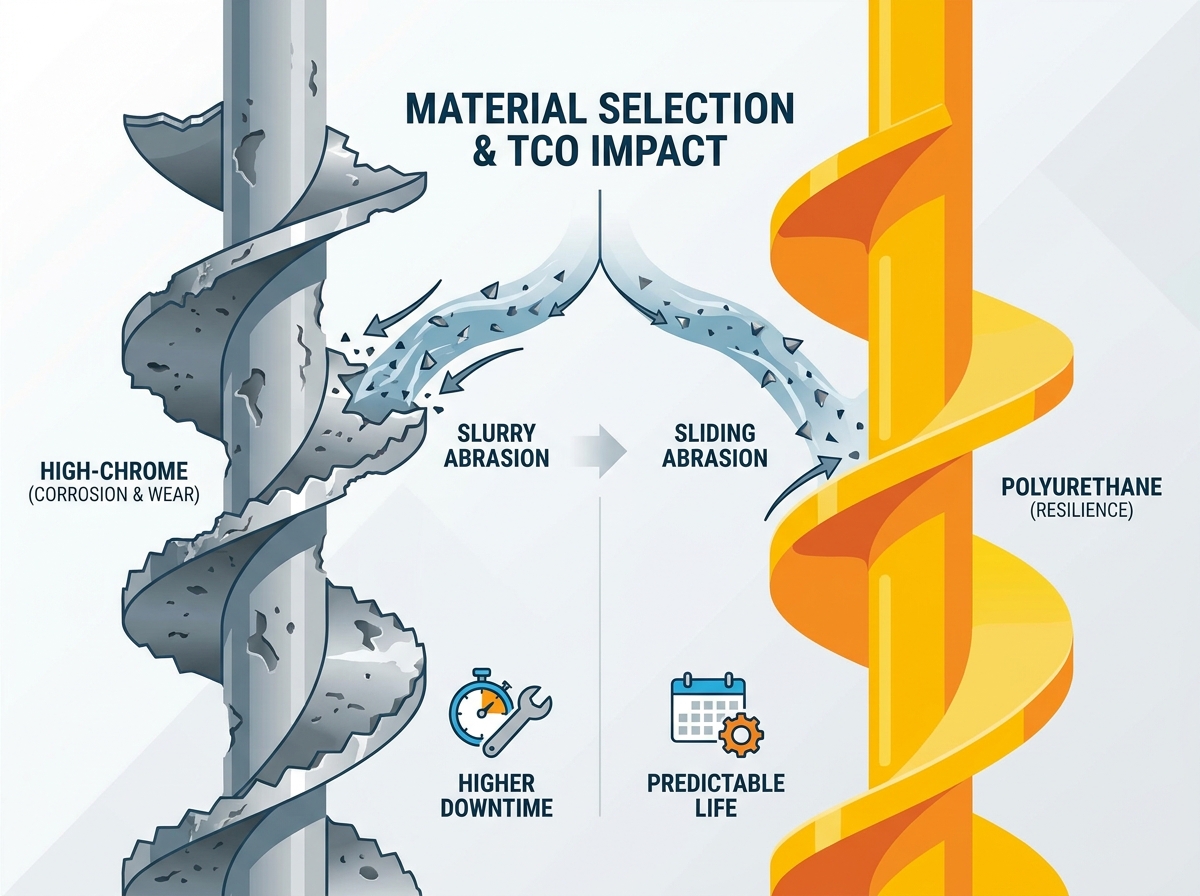
Operators must recognize specific failure modes early. Loss of edge profile ranks among the most common issues. The rounding and thinning of blade edges happen gradually. Worn edges reduce the spiral's ability to pull settled sands. They struggle to rake material up the incline efficiently. This rounding effect changes the hydrodynamics of the classifier. Sand slips back down into the pool instead of climbing. We frequently see this issue ignored until it causes major blockages. You should inspect the geometric tolerance of the blades regularly. A sharp, well-defined edge remains crucial for optimal raking performance.
Uneven wear distribution signals underlying mechanical problems. You might notice localized gouging on certain blade sections. Faster wear often occurs at the submerged pool end. This indicates specific flow irregularities inside the tank. It can also point to incorrect spiral alignment. We recommend checking the shaft positioning if you see this pattern. Sometimes, poor feed distribution causes uneven wear. If the slurry enters the tank from one side, it creates a localized abrasive zone. You can fix this by redesigning your feed box.
Blade degradation severely impacts your plant success criteria. Poor overflow clarity immediately follows edge wear. Coarse particle bypass contaminates your final product stream. This bypass overloads downstream ball mills rapidly. It creates a high circulating load. Your plant consumes more energy to process the same material volume. Worn Spiral Classifier Wear Blades silently drain operational profitability. Pumps wear out faster because they handle larger particles. You spend more money on electricity to grind recycled coarse material. Identifying these wear patterns early saves your plant significant capital.
Motor load variations provide another strong diagnostic clue. As blades lose their profile, they slip through the sand bed. The motor draws less amperage because it does less work. Conversely, if material builds up unevenly, the motor spikes. You should monitor your electrical draw carefully.
You have several material options for equipment upgrades. Material choice heavily influences maintenance frequencies. Upgrading your Mining Wear Parts requires careful analysis. You must match the material to your specific site conditions.
High-Chrome and Ni-Hard alloys offer exceptional hardness. They perform excellently for coarse ore processing. These metals handle highly abrasive materials well. The crystal structure of high-chrome resists cutting forces effectively. However, they come with notable drawbacks. They are extremely heavy and labor-intensive to replace. Installation requires specialized lifting equipment and rigging. They also remain susceptible to chemical corrosion. Acidic environments will eat away the matrix supporting the hard carbides.
Polyurethane elastomers provide a modern alternative. They show high resistance to fine sliding abrasion. Polyurethane is entirely corrosion-proof against acidic slurries. It bounces incoming particles away rather than resisting them rigidly. It is lightweight, which promotes safer and faster installation. Maintenance teams can often install these panels by hand. Yet, it has limitations in certain environments. Polyurethane can degrade under high temperatures. Large tramp metal impacts can destroy these synthetic parts instantly. Sharp rocks can tear the polymer surface if they strike it directly.
We suggest a structured evaluation framework for material selection:
Analyze your specific slurry characteristics carefully.
Measure the average particle size and sharpness.
Test the chemical pH levels of your water.
Assess the risk of tramp metal entering the circuit.
Match the material properties to your operational data.
Consider transitioning to polyurethane for acidic fine-particle slurries. This switch often increases predictable lifespan dramatically. High-Chrome remains the best choice for coarse rock applications. Some facilities employ hybrid material solutions successfully. They install high-chrome shoes at the heavy-wear pool end. They use polyurethane shoes further up the incline. This targeted approach balances cost, weight, and lifespan perfectly.
Material Type |
Ideal Application |
Primary Advantages |
Main Limitations |
|---|---|---|---|
High-Chrome / Ni-Hard |
Coarse, highly abrasive ores |
Exceptional hardness, impact strength |
Heavy, labor-intensive, corrosion-prone |
Polyurethane Elastomer |
Acidic, fine-particle slurries |
Corrosion-proof, lightweight, safe handling |
Sensitive to heat and large tramp metal |
Initial procurement prices rarely reflect the full financial impact. You must look beyond the initial purchase price. Premature equipment wear introduces massive hidden expenses. Buying cheaper replacement parts often costs you more money eventually. You need a comprehensive view of your operational expenditures.
Downtime and labor economics drain maintenance budgets quickly. You must calculate the hidden costs of emergency shutdowns. Confined-space entry permits require extensive administrative work. Safety lock-outs consume valuable shift time. Maintenance crew labor adds up during frequent shoe replacements. Every hour spent replacing parts is an hour of lost production. You pay wages for the repair crew while the plant sits idle. The economic penalty of downtime dwarfs the savings from cheap parts. Stockpiling critical spares reduces emergency freight costs. Air-freighting heavy steel parts destroys maintenance budgets instantly. Local supplier agreements help mitigate this supply chain risk.
Efficiency metrics reveal the true burden of worn components. Lost mineral recovery directly hurts plant revenue. Wasted grinding energy increases your monthly utility bills. Operating with worn components pushes secondary equipment harder. Pump impellers wear out faster when classifiers fail. Hydrocyclones receive improper feed pressures. You must factor these operational losses into your component evaluation. A highly efficient classifier maximizes the throughput of your entire plant. Worn parts bottleneck the entire operation silently. You should track your energy consumption against your classification efficiency.
Proper installation guarantees the longevity of your upgrades. Maintenance teams face several common installation risks. Improper bolting torque causes parts to vibrate loose. Loose parts suffer from accelerated wear and tear. Mismatched blade heights create an uneven raking surface. This unevenness disrupts the smooth flow of sand up the spiral. Failure to clean mating surfaces leads to improper seating. Slurry gets trapped behind the new plates and causes corrosion. You must clear all debris before bolting new parts. We strongly advise using anti-seize compounds on all fasteners. This makes the next replacement cycle much easier. Lubrication of the lower bearing assembly prevents moisture ingress. Slurry will destroy the bearings quickly if seals fail. Combine your blade inspection with a thorough bearing check.
Condition monitoring shifts your strategy from reactive to predictive. We outline a pragmatic inspection schedule below:
Measure blade thickness during every planned shutdown.
Inspect all mounting hardware for missing bolts.
Check for localized gouging near the pool end.
Document the wear rate variations between spirals.
Record changes in motor amperage during normal operation.
Regular inspections prevent catastrophic mechanical failures. You can order replacement parts well before the equipment breaks.
We strongly recommend a phased rollout for new materials. Do not convert the entire plant immediately. Test the new components on a single spiral first. You can also target a specific high-wear zone. Monitor the performance against your existing baseline data. This strategy minimizes operational risk during the transition. You gather valuable data without risking full plant throughput. Once the pilot proves successful, you can schedule a complete conversion.
Slurry abrasion remains an unavoidable reality in mineral processing. However, its impact on profitability is entirely controllable. Strategic material selection extends component life significantly. Proactive monitoring prevents catastrophic mechanical failures. You have the power to optimize your wet classification circuits.
We advise you to audit your current equipment wear rates. Document specific failure modes during your next shutdown. Analyze the data to find underlying operational issues. Consult with a qualified manufacturer to discuss alternative materials. Run an economic analysis focusing on downtime and labor savings. Implement a pilot test to validate performance improvements. Take action today to stabilize your classification circuits. Predictable maintenance schedules lead to higher overall plant throughput.
A: It depends heavily on slurry abrasiveness and your material choice. Standard practice dictates replacement when efficiency drops past a specific baseline threshold. You should not replace them strictly by a calendar date. Monitor the overflow clarity and replace parts when performance degrades.
A: Yes, they can handle coarse ores up to a certain particle size. However, they excel primarily in fine-to-medium particle sliding abrasion. High-chrome alloys are generally preferred for very coarse, heavy-impact applications. Large rocks can gouge or tear polyurethane surfaces easily.
A: Regular visual inspections during scheduled shutdowns work best. You should also track secondary indicators closely. Changes in the circulating load signal mechanical issues. Shifts in overflow density often indicate severe blade degradation. These indirect metrics help you spot problems early.
