

Views: 0 Author: Site Editor Publish Time: 2026-08-10 Origin: Site


High-impact feed aggressively accelerates wear in material processing operations. Processing large lump sizes, extreme compressive strength rock, and highly abrasive materials makes standard replacement schedules completely obsolete. When you operate under these severe conditions, guesswork is no longer an option.
Selecting the wrong cavity profile or incorrect metallurgy directly leads to premature wear. You might experience localized cupping, severely reduced throughput, and even potential catastrophic damage to your expensive crusher frame. These frequent failures disrupt daily operations and destroy site profitability.
This article provides a pragmatic, engineering-backed framework to solve these exact issues. You will learn how to evaluate cavity designs, select the proper metallurgy, and accurately time your maintenance intervals. Our primary goal is helping you minimize your operational cost-per-ton and maximize crucial equipment uptime.
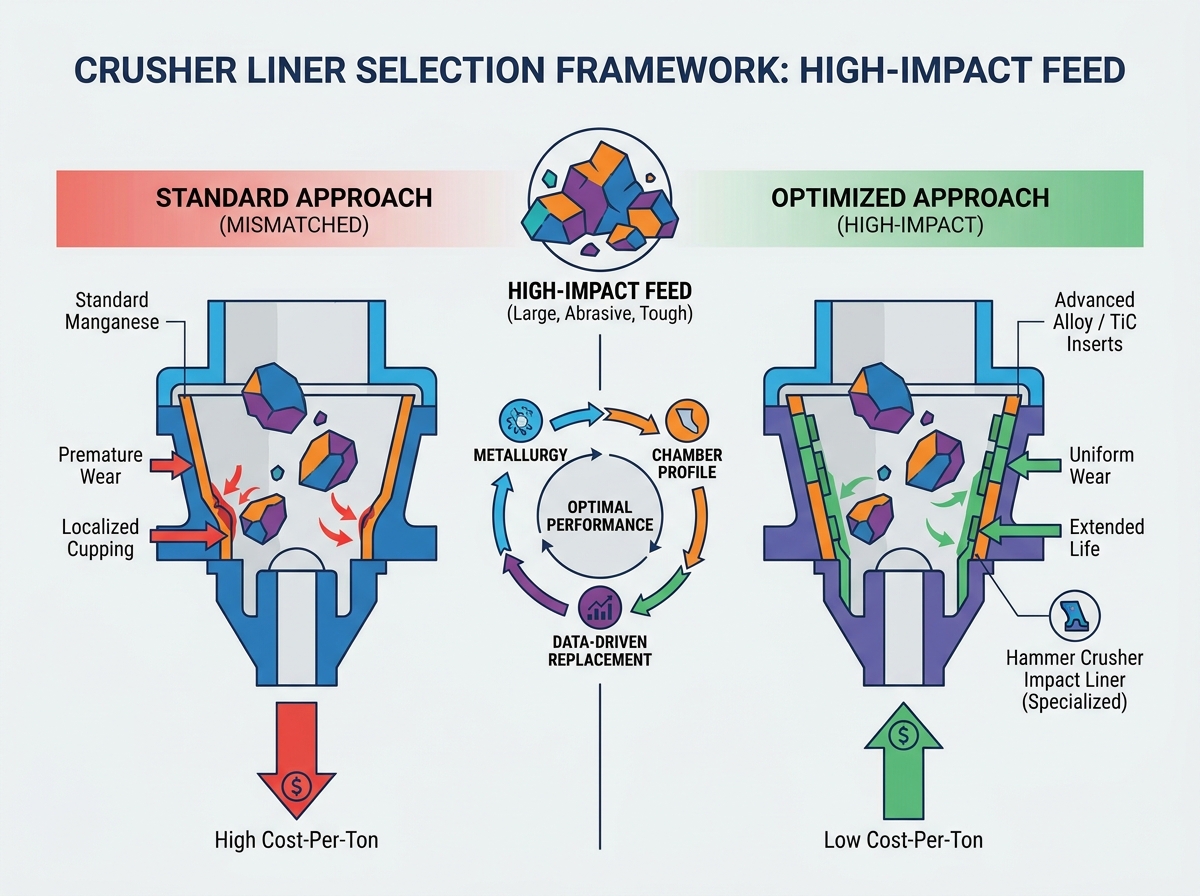
Material matching is critical: Standard manganese steel requires sufficient impact to work-harden; lacking this, or facing extreme abrasion, necessitates alloy or insert upgrades (e.g., Titanium Carbide).
Profile dictates performance: The chamber design must align with the specific high-impact feed size to maintain the correct nip angle and prevent choke-feed blockages.
Data-driven replacement: Changing liners based on tonnage or time is flawed; replacement should be dictated by power draw, drop in throughput, and strict minimum thickness thresholds.
Systematic trials: Upgrading to advanced materials (like a specialized Hammer Crusher Impact Liner) requires baseline tracking and controlled pilot testing before fleet-wide rollout.
Operations often underestimate the distinct challenges posed by high-impact feed. We must define what makes this feed uniquely destructive. High-impact feed significantly differs from standard, predictable aggregate. It includes blasted granite, large quartzite blocks, or recycled concrete containing heavy steel rebar. These materials exert massive compressive forces during the crushing cycle.
When you expose incorrect materials or poor chamber designs to these forces, specific failure modes quickly emerge. Standard aggregate might cause gradual, uniform wear. High-impact rock causes aggressive, localized destruction.
Common failure modes include:
Bell-mouthing: The lower crushing zone wears out far faster than the upper zone, destroying the closed-side setting (CSS) calibration.
Localized scouring: Abrasive fines trapped under high pressure gouge deep channels into the metal surface.
Micro-cracking: Extreme, repeated stress fractures brittle alloys, leading to large chunks breaking off during operation.
To combat these issues, operations must reframe their success criteria. Many buyers focus entirely on finding the lowest upfront part cost. This approach almost always loses money in the long run. Instead, evaluate components based on the lowest cost-per-ton processed. You must factor in the heavy labor costs required for frequent changeouts. Furthermore, you must calculate the exact production revenue lost during unexpected downtime. A cheaper part wearing out twice as fast costs significantly more over a fiscal quarter.
Common Mistake: Purchasing budget-grade parts for primary crushers handling blasted granite. The initial savings quickly evaporate due to forced, mid-shift maintenance stops.
Choosing the right metallurgy acts as the foundation of your wear strategy. You cannot guess which metal will perform best. You must match the alloy directly to the rock toughness and abrasion levels.
Manganese steel remains the industry standard for many applications. It relies on a unique metallurgical phenomenon called work-hardening. As heavy rock repeatedly strikes the metal surface, the outer layer compresses and hardens. The core remains ductile and absorbs massive shock. However, manganese requires constant, heavy impact to reach its optimal hardness. If your feed size drops, or if the rock lacks sufficient mass, the metal never hardens. It will simply wear away rapidly under abrasion.
Sometimes, high impact combines with extreme abrasion. Standard manganese cannot survive this dual threat. In these scenarios, you should evaluate Titanium Carbide (TiC) inserts. Manufacturers cast hard TiC columns directly into a durable manganese or alloy matrix. This provides the ultimate hybrid defense. The trade-off is clear: you pay a much higher initial cost. However, the inserts deliver an exponentially longer wear life, keeping your plant running uninterrupted for months.
Certain equipment setups demand specialized engineering. A Hammer Crusher Impact Liner serves as a distinct solution for specific rotor and impact setups. High-velocity impactors subject their internals to extreme, shattering forces. Standard cast iron shatters under this stress. Specialized hybrid alloys used in these specific liners resist catastrophic shattering. They maintain sharp, effective crushing edges much longer, ensuring a consistent product gradation.
You might also consider specialized upgrades like rubber feed cone liners. Rubber provides excellent, targeted shock absorption. It handles heavy, blunt impacts beautifully. However, we must highlight transparent assumptions regarding this material. Rubber excels at impact mitigation, but it struggles in other areas. It may not suit high-temperature environments. It also degrades quickly when exposed to highly abrasive, sharp fine feed.
Material Application Chart
Material Type | Primary Benefit | Ideal Application | Limitation |
|---|---|---|---|
14-22% Manganese | Work-hardens under stress | Large, heavy rock feed | Fails rapidly without high impact |
TiC Inserts | Extreme wear resistance | High impact + high abrasion | Higher initial capital expense |
Hybrid Steel Alloys | Shatter resistance | High-velocity impact crushers | Requires strict dimensional tolerance |
Rubber Composites | Maximum shock absorption | Heavy, blunt primary feed | Poor high-temperature performance |
Even the toughest metallurgy will fail if the cavity design is wrong. The chamber profile dictates how efficiently rock breaks inside the machine. You must evaluate the feed size against the actual feed opening.
The closed-side setting (CSS) and open-side setting (OSS) must actively dictate the profile you choose. If you mismatch the profile to the feed size, the rock crushes in the wrong zone. Oversized rock in a fine profile crushes too high in the chamber. This causes bridging and severely restricts throughput. Conversely, undersized rock in a coarse profile falls too low before breaking. This heavily concentrates wear at the very bottom of the mantle, ruining the part prematurely.
High-impact rock demands a highly precise nip angle. The nip angle is the angle formed between the mantle and the bowl. If this angle is too wide, the rocks simply bounce or slip upward. Bouncing wastes massive amounts of kinetic energy. It drastically reduces throughput and causes rapid, localized wear near the feed opening. Maintaining the correct nip angle ensures rocks are grabbed instantly and pulled downward efficiently.
Your cavity design must also account for how operators feed the machine. We classify feed methods into continuous (choke feeding) and intermittent (starved feeding).
Choke Feeding: The chamber remains completely full of rock. Rock-on-rock crushing occurs, reducing wear on the metal. This requires a specific, volumetric cavity design to prevent material packing.
Starved Feeding: The crusher receives intermittent batches of rock. The metal takes the full brunt of every impact. This scenario requires a thicker, more robust upper profile to handle direct strikes.
Best Practice: Always audit your actual feed gradation before ordering replacement parts. Never rely on the original OEM manual if your quarry conditions have changed.
Timing your replacements correctly prevents catastrophic failures. Many operators wait too long, trying to squeeze extra days out of worn parts. This strategy introduces severe implementation risks.
You should never change wear parts based on a calendar date or a rough tonnage estimate. Rock hardness fluctuates daily. Instead, track real-time operational metrics. Identify the specific warning signs of spent parts. Look for a sustained 10-15% drop in tons-per-hour (TPH). Monitor your product pile; an increasingly coarse product indicates the CSS can no longer be maintained. Finally, watch the power draw. A sustained spike in operating amperage means the machine is struggling to grab and break rock efficiently.
Visual inspections remain critical. Industry-standard minimum thickness rules dictate when you must pull the plug. You should never run equipment below 1 inch (25mm) at the thinnest point on the wear surface. Breaching this threshold eliminates the protective barrier. The immense crushing stress transfers directly through the thin metal into the mantle core or the bowl head. Machining damaged bowl heads costs tens of thousands of dollars.
Attempting to extend wear life past safe limits ignores implementation reality. Pushing parts too far leads directly to cracked frames. It destroys bronze bushings and damages complex eccentric assemblies. A single cracked frame costs significantly more than a dozen new wear parts. Establish a hard stopping point and strictly enforce it across your maintenance team.
Sourcing the right parts requires a systematic, disciplined approach. You must evaluate vendors critically and run controlled site trials.
The debate between OEM and aftermarket suppliers continues across the industry. Your goal is evaluating vendors based on technical capability, not just brand names. Look for suppliers offering transparent metallurgical certifications. They should gladly provide chemical composition breakdowns. They must guarantee accurate dimensional tolerances. Avoid vendors selling cheap, reverse-engineered copies. You want site-specific engineering tailored to your exact rock conditions.
Before buying anything, advise your maintenance team to map their current wear profiles. Pull the discarded parts out of the scrap pile. Take detailed photographs of the wear patterns. Measure the remaining thickness at various elevations. This wear audit acts as a diagnostic tool. It identifies exactly where the current design fails. If the bottom is completely worn while the top remains untouched, you need a different cavity profile.
Never overhaul your entire plant based on a brochure. We strongly recommend executing a controlled trial. When you decide to test new Crusher Liners, do not replace the fleet at once. Install the upgraded part on one single machine. Track the baseline metrics obsessively. Document the TPH, the daily power draw, and the final replacement interval. Calculate the true ROI based on cost-per-ton before you commit to a larger annual contract.
Selecting wear components for high-impact applications requires rigorous attention to detail. It remains a constant exercise in balancing correct metallurgy, precise chamber geometry, and strict maintenance protocols. Ignoring any of these three pillars guarantees higher operating costs and lower annual throughput.
There is no single "best" material in the aggregate processing industry. Standard manganese, titanium carbide, and specialized hybrid alloys all serve distinct purposes. Your success relies entirely on finding the most appropriate match for your site's specific rock hardness, feed size, and daily production targets.
Take immediate action to protect your crushing circuit. Schedule a professional wear audit this week. Measure your discarded parts, analyze your daily power draw, and request a customized metallurgical recommendation based strictly on your current crushed rock data.
A: Differentiate based on your crusher type and the primary wear mechanism. Cone and jaw crushers utilizing compression rely heavily on standard manganese to work-harden under immense pressure. High-velocity impactors require specialized hybrid alloys. These impactors face extreme shattering forces, so they need distinct impact components to resist cracking while retaining sharp edges.
A: Yes. Upgrading to a properly matched cavity profile maintains the optimal nip angle much longer. A correct nip angle instantly grabs rock and prevents bouncing. This keeps your crushing efficiency incredibly high, stabilizes power consumption, and pushes more tons through the machine every single hour.
A: The biggest mistake is using a profile designed for fine or medium feed to crush oversized, high-impact rock. This error leads directly to bridging and severe blockages at the feed opening. It wastes massive amounts of energy and places highly destructive stress on the upper chamber components.
