

Views: 0 Author: Site Editor Publish Time: 2026-07-30 Origin: Site


Premature wear part failure plagues many industrial crushing operations. Unplanned downtime drains site profitability rapidly. Operators often blame inherent manufacturing defects for broken or worn components. However, the true culprit is usually a severe mismatch between feed material characteristics and component specifications. Industrial quarries demand high efficiency. You cannot afford arbitrary part selection.
Fluctuations in feed size distribution drastically alter internal machine mechanics. Moisture content variations shift wear profiles from predictable abrasion to catastrophic impact. They also cause severe localized gouging on metal surfaces. To maximize operational returns, you must align metallurgy and profiles with empirical feed data. Standard OEM replacements no longer suffice for dynamic environments. We will explore how feed size and moisture dictate part lifecycles. You will learn to match specific alloys to your unique site conditions effectively.
Oversized feed induces high-stress impact fatigue, while an abundance of fines accelerates abrasive wear, requiring different alloy yield strengths.
Moisture exceeding 4–5% creates an abrasive paste that exacerbates cavity packing, exponentially increasing the stress load on liners and frames.
Selecting the right metal crusher hammer and liner requires evaluating the balance between impact resistance (toughness) and abrasion resistance (hardness) specific to site conditions.
Evaluating wear parts on a "Cost Per Ton" (CPT) metric rather than upfront purchase price is the only reliable indicator of true operational efficiency.
Feeding oversized material creates massive operational hurdles. The nip angle determines the optimal capacity of any crushing cavity. Exceeding this capacity forces extreme localized stress on the equipment. The crusher struggles to grip massive rocks properly. The boulders bounce inside the chamber rather than breaking cleanly. This bouncing induces severe micro-fractures deep within the metal structure. You will likely experience premature work-hardening failures shortly after installation. Operators frequently observe severe localized gouging on the upper chamber sections. This gouging ruins the geometry of the entire crushing cavity.
Conversely, undersized feed presents entirely different mechanical challenges. Excessive fines lead to a destructive phenomenon called channelling. Fine material bypasses the primary crushing zones entirely. It flows like fluid down the path of least resistance. This concentrated flow causes deep abrasive wear at the lower discharge point. Industry professionals call this bell-mouthing. Bell-mouthing destroys the intended liner profile rapidly. High-quality crusher wear parts require proper feed sizing to reach their maximum operational lifespan.
To solve these issues, you must prioritize continuous evaluation. Assess your historical wear profiles meticulously. Examine discarded liners closely during maintenance cycles. Ask your maintenance team specific questions regarding the wear patterns. Is the wear heavily localized in specific cavity zones? Is it evenly distributed across the entire chamber? Localized wear proves your current feed size is misaligned. It no longer matches the existing liner profile. You must adjust your strategy immediately to prevent further damage.
Sample the raw feed material regularly to monitor size fluctuations.
Use automated camera systems over conveyors to track particle size distribution.
Train operators to identify the sound of bouncing rocks in the chamber.
Inspect the upper cavity weekly for unexpected gouging patterns.
Compare current worn profiles against the original OEM blueprints.
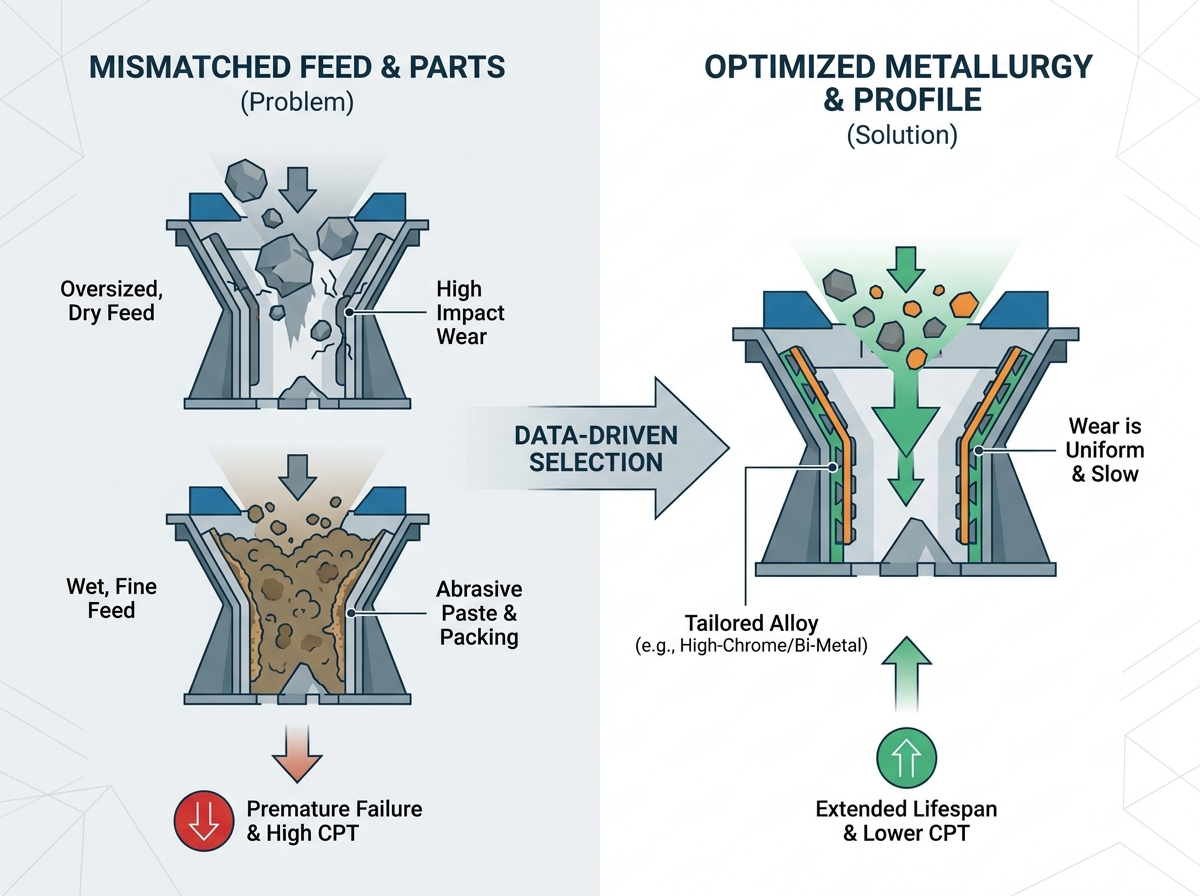
Moisture drastically changes internal mechanical dynamics. When moisture content surpasses critical thresholds, operational problems compound quickly. This threshold usually sits around five percent. However, it depends heavily on specific clay or silica concentrations in the rock. Fines bind together rapidly under high moisture conditions. They coat the internal wear surfaces completely. This creates an aggressive, abrasive paste inside the machine. It acts exactly like industrial sandpaper. It continuously scours the metal as the machine operates under heavy loads.
This abrasive paste leads directly to severe cavity packing. Wet, sticky material fails to flow properly through the chamber. It cannot exit the discharge opening efficiently. Operators often refer to this blockage as pancaking. The material builds up rapidly inside the enclosed space. It subjects the internal components to unyielding hydraulic-like pressure. This pressure destroys expensive components quickly. It drastically reduces the lifespan of essential Crusher Wear Parts. Furthermore, it risks catastrophic main shaft or bearing failures.
You must adopt a skeptical lens regarding standard metallurgical solutions. Standard manganese steel requires heavy impact to work-harden correctly. Moisture causes cavity packing almost immediately. This packing dampens the necessary impact forces. The incoming rocks hit a cushion of mud instead of hard steel. Therefore, the manganese never achieves its optimal surface hardness. It remains in its softer, ductile austenitic state. This leads directly to rapid, unpredictable wear rates.
Ignoring seasonal weather changes affecting stockpile moisture levels.
Relying on standard manganese steel for wet, sticky clay applications.
Failing to clear packed material during routine maintenance shifts.
Operating the equipment past safe hydraulic relief pressure limits.
Neglecting to install water sprayers correctly, adding unnecessary moisture.
You must align metallurgical specifications with empirical feed data. Selecting the correct alloy prevents catastrophic failures. Different materials react uniquely to impact and abrasion.
This alloy remains the traditional industry standard for many operations. It performs best for large, dry feed material. It requires high impact forces to transform into a hardened state. The surface hardens while the core remains ductile and tough. It is a poor choice for high-fines environments. It also fails in high-moisture environments where impact is severely dampened. The metal simply wears away before the hardening process occurs.
These materials are ideal for extreme high-abrasion applications. They perform exceptionally well in lower-impact environments. The dense chromium carbides resist scouring from abrasive pastes effectively. This is a critical factor when selecting a Metal Crusher Hammer and Liner. They handle smaller, highly abrasive feeds perfectly. They maintain their intended geometric profile much longer than manganese. However, they can shatter under massive, uncrushable impacts.
These represent the premium solution for complex, highly abrasive operations. They handle environments dealing with highly variable feed sizes seamlessly. They offer extreme impact toughness alongside maximum abrasion resistance. The ceramic matrix resists brutal grinding forces. Meanwhile, the steel backing absorbs heavy mechanical shocks without fracturing.
Alloy Application Guide
Alloy Category | Optimal Feed Size | Moisture Tolerance | Primary Mechanical Strength |
|---|---|---|---|
Standard Manganese (14-22%) | Large boulders | Low (Under 4%) | High impact resistance |
High-Chrome / Martensitic | Small abrasive fines | Moderate (4-7%) | High abrasion resistance |
Bi-Metal / Ceramic Composites | Variable mixed feed | High (Over 7%) | Hybrid durability and toughness |
Do not accept standard OEM alloys blindly. You must demand accountability from your parts suppliers. Ask them to provide full metallurgical certifications for every casting. Request historical case studies for similar industrial applications. Ensure these case studies match your specific feed size precisely. They must also align with your local moisture profiles. Customization is the only way to ensure maximum component longevity.
Upgrading your metallurgical strategy introduces new operational variables. You must mitigate implementation risks carefully. A structured rollout prevents costly operational surprises and sudden failures.
Transitioning to a new alloy requires strict, controlled testing. You might change a liner profile to combat moisture buildup. You must isolate your operational variables first to measure success. Run a dedicated control test on the equipment for a set duration. Monitor your feed scales with extreme precision daily. Use digital moisture sensors to track water content constantly. Record the data in a central log to establish a firm baseline. This data proves whether the new alloy actually performs better.
You cannot manage what you do not measure accurately. Implement regular 3D laser scanning protocols for your equipment. Scan the crushing cavity during scheduled maintenance shifts. Millions of data points create a topographical map of the liner. Alternatively, utilize ultrasonic thickness testing on the components. Build a verifiable wear curve using this empirical data. A wear curve predicts exactly when a part will fail. It removes dangerous guesswork from your maintenance schedule.
Conduct a comprehensive site audit immediately before ordering new components. Document the exact feed size distribution mathematically. Analyze the silica content of your rock through lab testing. Track seasonal moisture variations meticulously across different weather patterns. Gather this extensive data before requesting any RFP bids. Suppliers need this exact information to engineer proper replacement parts. Providing vague details guarantees suboptimal metallurgical recommendations.
Feed size and moisture are not just minor operational annoyances. They are the primary dictates of wear part performance. They determine exactly which metallurgy and profile your equipment requires. You must shift your procurement strategies today. Move away from reactive, blind replacement habits entirely. Embrace proactive, data-driven engineering solutions instead. Partner exclusively with suppliers who engineer parts based on operational reality. They must understand your exact feed chemistry and mechanical constraints. By mapping component specifications to your actual feed data, you eliminate unpredictable downtime. You also secure a significantly longer lifecycle for every piece of metal inside your crushing chamber.
A: Generally, 4-5% moisture is the threshold before packing and accelerated abrasive wear occur, though this depends heavily on the presence of clay or sticky fines.
A: Fines dampen the heavy impacts required for manganese steel to "work-harden." Without work-hardening, the metal remains in its softer state and wears away rapidly through abrasion.
A: Yes, custom profiles (like thicker lower sections or specific tooth designs) can optimize the nip angle and material flow, partially mitigating the adverse effects of oversized or poorly distributed feed.
A: Track the Cost Per Ton (CPT). Divide the total cost of the parts plus the cost of installation downtime by the total tonnage of material produced during the part's operational lifecycle.
