

Views: 0 Author: Site Editor Publish Time: 2026-08-12 Origin: Site


Processing highly abrasive materials like quartzite, granite, and basalt presents a massive operational challenge. These hard rocks rapidly accelerate wear on standard machine internals. You quickly face soaring cost-per-ton metrics. Unplanned downtime also cripples your production schedule. There is no universal "best" material for these harsh environments. The optimal choice requires a precise engineering calculation. You must carefully balance impact force against abrasion resistance. You also need to match the metallurgy strictly to your equipment type.
This guide gives you a proven framework for evaluating wear materials. You will learn how to select the exact components based on your site conditions. We will explore how different alloys respond to mechanical stress. You will discover how to match specific metals to your primary, secondary, and tertiary crushing stages. Selecting the right Crusher Liners ensures you maximize component lifespan and keep your plant running efficiently.
Manganese steel remains the baseline for primary crushing due to work-hardening properties, but specific alloys (14%, 18%, 22%) must match the feed’s impact level.
High-chrome and ceramic-composite metal crusher wear liners offer vastly superior abrasion resistance for secondary/tertiary stages but carry high fracture risks under heavy impact.
Total Cost of Ownership (TCO) should dictate selection, prioritizing predictable changeout schedules over the lowest initial purchase price.
Incorrect material selection not only accelerates wear but can cause catastrophic failure to the crusher's foundational components.
Establishing success requires looking beyond upfront component prices. You must set a baseline metric for evaluating performance. A simple cost-per-ton target serves this purpose best. It measures how effectively the part processes rock before it requires replacement. Tracking this metric reveals the true value of premium materials. A cheaper casting might look attractive initially. However, if it wears out twice as fast, your overall cost-per-ton skyrockets.
Predictability of wear is equally critical. Reliable, linear wear profiles allow you to schedule maintenance accurately. You can plan changeouts during standard shutdown periods. This prevents unexpected mid-shift failures. Unplanned downtime destroys profitability faster than expensive replacement parts. When a liner wears unevenly, you risk damaging the parent machine. Predictable wear keeps your operation safe and efficient.
You also face a core engineering trade-off. This is the impact versus abrasion ratio. Materials highly resistant to sliding abrasion usually act brittle under heavy direct impact. High impact demands toughness and ductility. High abrasion demands extreme hardness. You rarely get both without compromise. A primary jaw crusher receives massive impact forces. It requires ductile steel. A tertiary impact crusher sees less impact but extreme sliding abrasion. It demands high hardness. Evaluating your specific ratio is the first step in material selection.
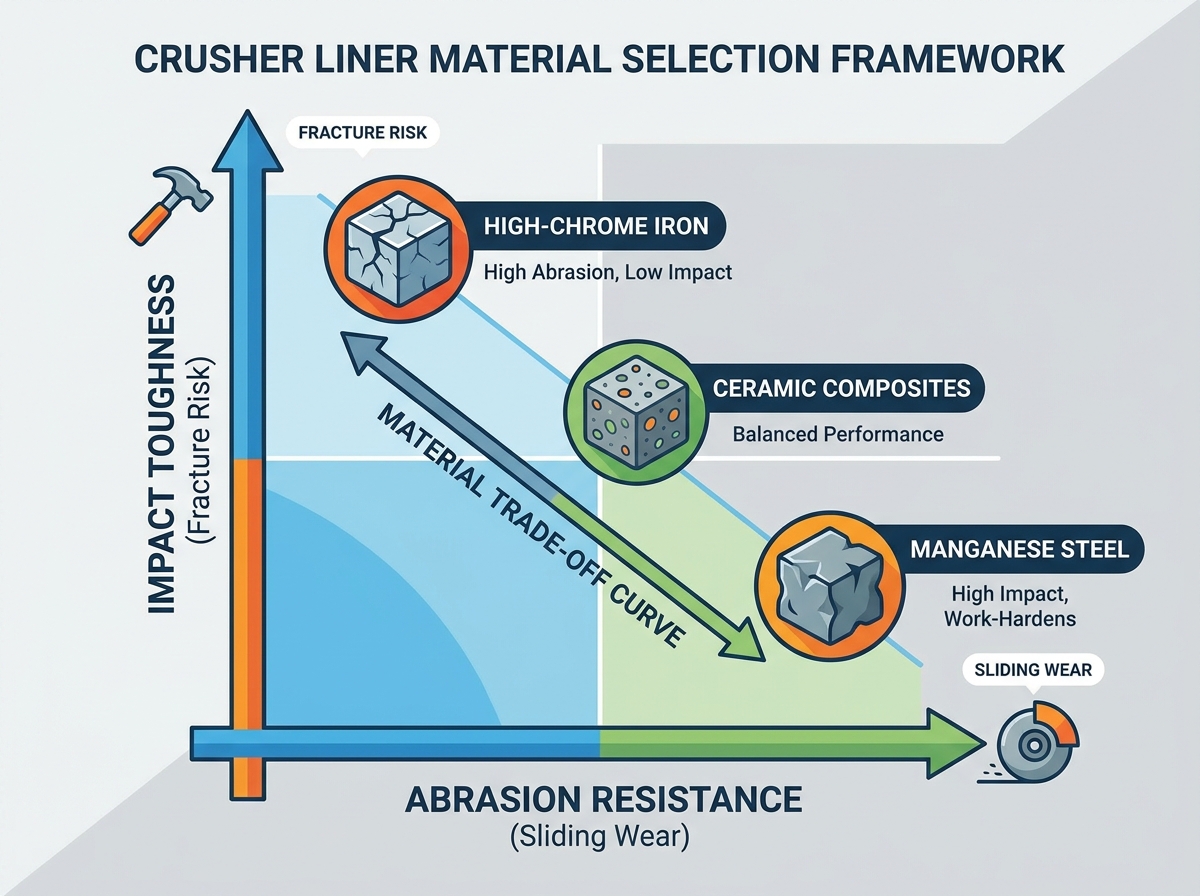
When you evaluate a Metal Crusher Wear Liner, you will encounter several distinct metallurgical families. Each alloy behaves differently under stress. Understanding their underlying mechanisms helps you prevent premature failures.
Austenitic manganese steel is often called Hadfield steel. It serves as the baseline for the aggregate industry. The mechanism is fascinating. The metal work-hardens upon impact. When heavy rocks strike the surface, the crystal structure compresses. The outer layer becomes exceptionally hard and abrasion-resistant. Meanwhile, the inner core remains ductile and tough. It absorbs massive shocks without shattering.
We typically recommend this material for primary jaw and cone crushers. It thrives in high-impact applications with large-feed abrasive rocks. However, manganese steel has severe limitations. It fails prematurely in high-abrasion, low-impact environments. If the rock does not hit the metal hard enough, the surface never hardens. The soft steel will simply wash away under sliding abrasion. You must match the manganese grade to your rock size.
High-chrome white iron offers maximum resistance to sliding and gouging abrasion. It achieves an extremely high hardness rating, often reaching 60 to 65 HRC (Rockwell Hardness Scale). The chromium carbides form a dense, impenetrable matrix. This makes it virtually immune to the scraping action of quartzite and sandstone.
This material works best for impact crusher blow bars. It is also excellent for tertiary crushing stages with controlled, small feed sizes. The major limitation is its extreme brittleness. High-chrome carries a catastrophic fracture risk. If tramp metal enters the crushing chamber, the liner will likely shatter. An oversized feed rock can cause the same catastrophic failure. You must maintain strict feed control when using high-chrome alloys.
These represent the cutting edge of wear technology. They are hybrid solutions. Foundries embed hard ceramic particles into a tough martensitic steel matrix. The steel absorbs the physical shocks. The ceramic inserts resist the sliding wear. It gives you the best of both worlds.
These composites are best for environments requiring moderate impact resistance and extreme abrasion resistance. Highly abrasive secondary crushing is the perfect application. The primary limitation is the initial investment. CMCs command a premium price point. You must justify this through extended wear life and reduced maintenance cycles. They often outlast standard alloys by a factor of two or three.
Not all wear liners are metal. Rubber and polyurethane mitigate wear through elastic deformation. Instead of fighting the rock with hardness, they absorb the kinetic energy. The material flexes and bounces back.
These synthetic alternatives excel in specific secondary and tertiary applications. They are highly effective on screens and transfer points. They drastically reduce plant noise. Furthermore, they handle wet, sticky abrasive feeds much better than steel. Wet clay often builds up on metal surfaces. Rubber panels flex and shed this sticky material, keeping your process flowing.
You cannot use a generic approach when outfitting different machines. A cone crusher behaves differently than an impactor. You must tailor your material selection to the specific mechanical actions of your equipment. Properly matched crusher liners will drastically improve your daily tonnage.
Here is a material suitability chart to reference during your selection process.
Equipment Type | Crushing Stage | Recommended Material | Primary Risk Factor |
|---|---|---|---|
Jaw Crusher | Primary | 11% - 14% Manganese | Lack of work-hardening if feed is too soft. |
Cone Crusher | Secondary | 18% Manganese or CMCs | Localized cupping from improper feed gradation. |
HSI / VSI Impactor | Tertiary | High-Chrome White Iron | Shattering from tramp metal or oversize feed. |
Transfer Chutes | Handling | Polyurethane / Rubber | Tearing from sharp, heavy oversize rocks. |
For jaw crushers, you must focus on the tooth profile and the exact manganese grade. The fixed and moving jaws endure immense compressive forces. Higher impact requires lower manganese content. Standard 14% manganese provides the ductility needed to prevent cracking under massive boulders. If you face high abrasion but lower impact forces, you should upgrade to 18% or 22% manganese. This higher grade provides a better initial hardness. Also, consider the tooth profile. Corrugated profiles grip the rock better, while flat profiles handle slabby material more efficiently.
Cone crushers utilize a mantle and a bowl liner. Selection must account for your specific crushing chamber profile. You must match the alloy to the feed gradation. Evaluate the risk of "cupping." Cupping occurs when localized wear creates a groove in the metal. This usually happens when the feed material is improperly graded, forcing the crusher to do all the work in one narrow zone. If your rock is extremely hard, consider a ceramic matrix composite for the mantle. It holds its profile much longer, ensuring a consistent product shape.
Horizontal and Vertical Shaft Impactors require careful balancing. You must balance the blow bar metallurgy against the rotor speed. High rotor speeds generate massive kinetic energy. If you use high-chrome liners at high speeds, you face strict limitations on feed size. A large rock hitting a high-chrome blow bar at high speed will cause it to shatter. You must ensure rigorous screening ahead of the impactor. If your feed size fluctuates, you should downgrade to a martensitic steel. It offers better safety margins against fracture.
Audit your current feed material size and hardness (Bond Work Index).
Document the exact rotor speeds and closed-side settings of your machines.
Identify your primary failure mode: are parts thinning out, or are they cracking?
Select an alloy that addresses the specific failure mode identified.
Monitor the first installation daily to verify the wear profile.
Selecting the right material on paper is only half the battle. Poor manufacturing or improper installation will ruin even the best alloy. You must implement rigorous quality assurance protocols. Paying attention to these details prevents disastrous equipment failures.
Metallurgical quality control easily overrides material specifications. A poorly cast 18% manganese liner will fail faster than a perfectly cast 14% liner. You must watch out for shrinkage cavities and porosity. These internal voids act as stress concentrators. They cause the part to crack under pressure.
Heat treatment is equally vital. Manganese steel requires rapid water quenching to achieve its ductile properties. If the foundry cools it too slowly, the carbon precipitates out. The metal becomes brittle and useless. Always request foundry certifications. You need verifiable proof of their heat treatment logs and chemical composition tests. Do not accept parts with visual surface defects or excessive grinding marks.
Cone and gyratory crushers require backing compound between the liner and the parent machine. This acts as a shock absorber. It requires a high-quality, specialized epoxy. Never cut corners on your backing material.
Common mistakes occur during pouring. If you pour the epoxy at the wrong temperature, it will not flow correctly. This creates air voids. Voids in the backing lead directly to cracked liners. When the rock strikes the unsupported metal, the liner flexes into the void and snaps. This happens regardless of how strong the alloy is. Ensure your maintenance team follows strict volumetric mixing and temperature guidelines during installation.
The first 24 to 48 hours of operation are critical. This is especially true for manganese steel. You cannot start a newly lined crusher at full capacity. You must follow strict operational guidelines.
Begin by choke-feeding the crusher with smaller, well-graded material. This allows the manganese to work-harden gradually. If you immediately dump massive boulders into a fresh jaw crusher, the soft metal will deform rather than harden. The metal can actually flow and stretch, making it impossible to remove the parts later. Proper break-in protocols ensure the outer layer hardens correctly without compromising the ductile core.
Finding the best material for abrasive applications is an ongoing engineering process. It is always application-specific. Your choice is dictated by feed size, rock hardness, and crusher mechanics. What works for a neighboring quarry might fail miserably in yours.
Your shortlisting logic should always start with an audit. Examine your current wear patterns closely. Identify your failure modes. Are your parts cracking from impact, or are they rapidly thinning from sliding abrasion? You must answer this before changing material types. Transitioning to a harder alloy without addressing impact forces will only lead to broken components.
Your next step is to act strategically. We recommend partnering with a specialized wear-parts engineer. Have them conduct a thorough site audit and metallurgical analysis. Do not buy purely based on catalog specifications. A tailored approach ensures you maximize production uptime and minimize your operational headaches.
A: Usually not for primary crushers. High-chrome lacks the necessary ductility to handle massive shocks. It becomes a severe fracture risk in large-feed or high-impact stages. Upgrading requires a careful assessment of impact forces. High-chrome should generally be reserved for secondary or tertiary stages with controlled, smaller feed sizes.
A: Higher manganese alloys require significantly higher impact forces to work-harden. If your rock is highly abrasive but lacks sufficient mass or kinetic energy, the 22% manganese surface will not compress. It remains soft and wears rapidly. Matching the alloy to the rock's impact potential is crucial.
A: Ceramic matrix composites combine two distinct advantages. They utilize the high impact resistance of a base metal, like martensitic steel, alongside the extreme abrasion resistance of ceramic. The steel absorbs the shock, while the ceramic resists the scraping. This often doubles or triples wear life in abrasive conditions.
A: Frequent tramp metal occurrences restrict your material options. You cannot use brittle, highly abrasion-resistant materials like high-chrome if uncrushable steel regularly enters the chamber. Tramp metal forces you to select tougher, more ductile alloys, like manganese, to prevent sudden and catastrophic part failures.
