

Views: 0 Author: Site Editor Publish Time: 2025-10-13 Origin: Site


Efficient mineral processing is the backbone of the mining industry, and grinding plays a pivotal role in extracting valuable minerals from ores. At the core of grinding operations lies the grinding ball, an essential component in both SAG (Semi-Autogenous Grinding) mills and traditional ball mills. Proper selection and utilization of grinding balls significantly influence mill performance, energy consumption, ore particle size, and overall operational efficiency.
Grinding balls serve as the primary grinding media inside mills, responsible for breaking down ore into finer particles suitable for downstream processing. In mining operations, the efficiency of grinding directly affects the recovery of minerals, energy consumption, and the lifespan of milling equipment.
Without properly selected grinding balls, mills may face challenges such as inconsistent particle size, high energy usage, frequent maintenance, and lower throughput. In essence, grinding balls are not merely consumables—they are strategic assets that determine the effectiveness of mineral processing.
Grinding balls are typically manufactured from steel, chromium steel, or special alloys, each providing specific properties for different milling conditions. The main criteria for grinding ball materials are:
Hardness: The ability to crush ore effectively without excessive deformation.
Toughness: Resistance to cracking and breaking under repeated impact.
Wear resistance: Long-lasting performance, minimizing the need for frequent replacement.
High-quality grinding balls maintain their shape and size for extended periods, ensuring consistent grinding performance and reduced downtime.
Grinding balls are categorized into three main types based on their manufacturing process and shape:
Produced by pouring molten steel into molds and allowing it to solidify.
Offers uniform hardness and consistent size.
Suitable for general grinding in SAG and ball mills.
Cost-effective and widely used in large-scale operations.
Manufactured by compressing and shaping heated steel billets under high pressure.
Superior toughness and wear resistance compared to cast balls.
Ideal for hard ores and demanding milling conditions.
Less prone to cracking, extending service life and reducing maintenance frequency.
Cylindrical grinding media designed to maximize contact efficiency.
Offers higher grinding efficiency for certain mill configurations.
Commonly used in cement and heavy-duty mining mills.
Provides reduced energy consumption per ton of ore processed.
Grinding balls come in various diameters, typically ranging from 20 mm to over 120 mm. The selection of ball size affects the grinding efficiency:
Larger balls: Effective in coarse grinding, especially in SAG mills.
Smaller balls: Used for fine grinding, ensuring uniform particle size.
Mixed sizes: Optimize energy transfer and accommodate ores with varying hardness.
Proper ball size distribution ensures maximum ore contact and minimizes energy wastage.
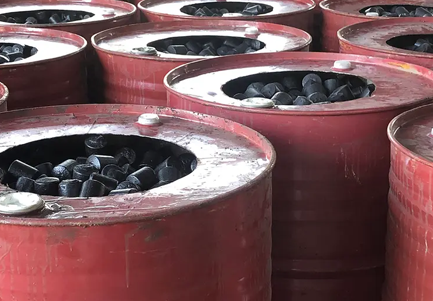
Grinding balls play a critical role in mining operations across a wide range of ore types. Their primary function is to reduce ore size, increase surface area, and prepare the material for downstream processes such as flotation, leaching, or smelting. Proper selection and use of grinding balls not only enhance milling efficiency but also reduce energy consumption, improve mineral recovery, and extend the lifespan of milling equipment.
SAG (Semi-Autogenous Grinding) mills are typically used to process coarse and hard ores, and they rely heavily on grinding balls to enhance the cascading and impact action inside the mill. In SAG mills:
Grinding balls help break down large ore chunks into smaller, more manageable pieces, facilitating subsequent grinding stages.
They transfer energy efficiently, reducing the need for excessive milling and preventing unnecessary wear on mill liners.
The presence of high-quality grinding balls optimizes mill throughput, ensuring that more ore can be processed per hour while lowering energy consumption per ton of material.
High-hardness steel balls are particularly effective in SAG mills due to the high-impact environment. Their superior toughness and wear resistance allow them to withstand repeated collisions with ore and other balls, minimizing cracking and media degradation. Additionally, using the correct ball size distribution in SAG mills ensures maximum ore contact, enhancing grinding efficiency and uniformity of the output.
Ball mills are commonly used for fine grinding, transforming partially crushed ore into uniform powders suitable for downstream mineral recovery processes. In ball mill operations, grinding balls serve several important functions:
They provide a consistent particle size, which is crucial for optimizing flotation efficiency and other mineral extraction methods.
Properly selected grinding balls help reduce over-grinding, which not only saves energy but also prevents the generation of excessively fine particles that may complicate subsequent processing.
They maintain efficient milling performance by combining hardness and wear resistance, ensuring that the balls do not deform or wear prematurely.
Choosing the right grinding media for ball mills allows operators to maximize throughput, minimize downtime for media replacement, and reduce operational costs. For example, using forged or high-chromium balls in high-stress mills can significantly extend the service life of the media, leading to more consistent grinding and lower maintenance requirements.
Different ore types require specific grinding strategies, and the selection of grinding balls must be tailored accordingly:
Copper ores: These ores require a balance between hardness and toughness. Using grinding balls with the appropriate properties ensures efficient size reduction in both SAG and ball mill stages while minimizing media wear.
Gold ores: Fine grinding is essential to maximize gold extraction. High-hardness steel balls reduce over-grinding and prevent excessive wear, ensuring consistent particle size and improved recovery rates.
Iron ores: Coarse grinding in SAG mills benefits from the use of larger, high-toughness grinding balls. This allows the ore to be broken down efficiently without excessive energy consumption or premature media failure.
By carefully matching grinding ball type, size, and material to the characteristics of the ore, mining operations can achieve higher mineral recovery, lower energy usage, and more consistent mill throughput. In addition, this approach reduces operational costs by minimizing media replacement frequency and lowering the risk of mill downtime due to inefficient grinding or equipment wear.
Grinding performance is influenced by several key factors, which determine the efficiency and cost-effectiveness of the milling operation.
High-hardness steel balls withstand repeated impact without deformation.
Superior wear resistance reduces the frequency of media replacement, lowering downtime.
Consistent hardness ensures uniform particle size throughout the milling process.
Proper ball diameter and load ratio maximize ore contact.
Mixed-size media are often used to handle ores with variable hardness.
Optimal loading enhances energy transfer efficiency, improving mill throughput.
Reduced operational costs due to lower replacement frequency.
Minimized wear on mill liners.
Improved energy efficiency per ton of ore processed.
Consistent grinding ensures better downstream processing results.
Using the right grinding balls provides multiple operational advantages:
Increased Productivity: Consistent particle size ensures mills operate at optimal throughput.
Reduced Maintenance Costs: Durable grinding balls minimize downtime and media replacement.
Energy Efficiency: Proper media selection improves energy transfer, lowering power consumption.
Enhanced Ore Recovery: Uniform grinding leads to improved mineral extraction in flotation or leaching processes.
Proper grinding media selection is a strategic investment that directly impacts mining profitability and operational sustainability.
Grinding balls are essential for efficient mining ball mill operations, with material, size, and hardness directly affecting mill performance, energy use, and operational costs. Choosing the right media—cast, forged, or cylindrical—ensures consistent particle size, extended equipment life, and reduced maintenance. For mining operators aiming to maximize productivity and optimize ore recovery, consulting high-quality suppliers such as Anhui Ningguo Zhongrui Wear-resisting Material Co., Ltd. can provide tailored grinding ball solutions that meet specific mill conditions and ore characteristics, supporting long-term, cost-effective, and sustainable operations.


