

Views: 0 Author: Site Editor Publish Time: 2026-07-29 Origin: Site


Profitability in aggregate and mining operations lives and dies in the margins. Rising energy costs and strict environmental regulations squeeze operator margins tighter every year. You win or lose based directly on your operational expenditure (OPEX). Every cent saved per ton crushed directly boosts your bottom line. Unfortunately, procurement teams often fixate purely on the initial purchase price of consumables. This narrow viewpoint creates a massive problem. Cheap consumables consistently trigger expensive operational nightmares.
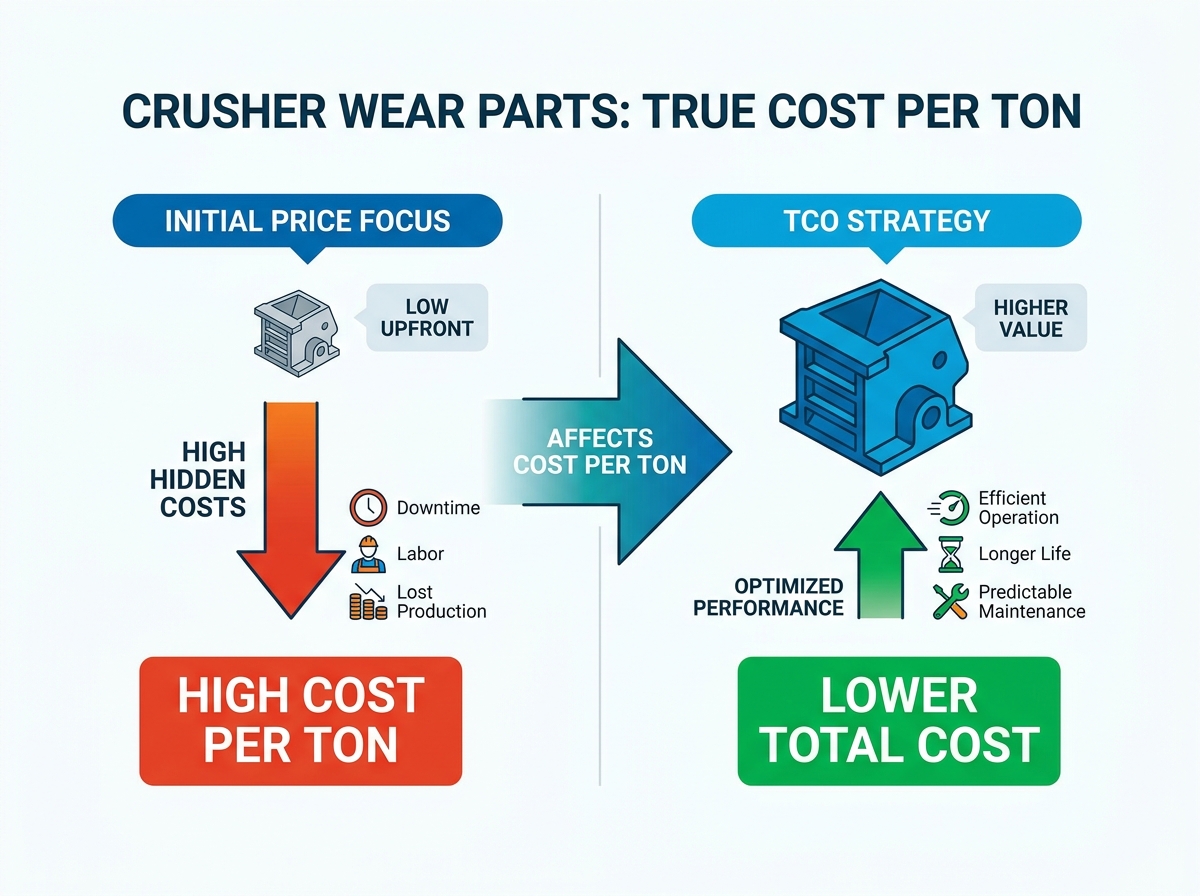
Ignoring the true operational cost leads to frequent downtime, wasted labor, and lost production. Equipment sits idle while repair crews struggle with premature part failures. In this article, we will show you how strategic selection and management of Crusher Wear Parts immediately reduces your overall cost per ton. You will discover practical methods to evaluate true operational expenses, align metallurgical choices with specific applications, and optimize your feeding processes. Let us dive into the mechanics of transforming consumable expenses into a measurable competitive advantage.
The TCO Formula: Initial part price is a fraction of true cost; downtime, labor, and maintenance dictate your actual cost per ton.
Material Strategy: Matching the correct alloy (e.g., manganese vs. chrome) to your specific rock abrasiveness and impact level prevents premature failure.
Hidden Profit Leaks: Substandard wear parts cause uneven wear profiles, reducing crushing efficiency, product shape, and throughput.
Supplier Evaluation: Choosing a wear part partner requires evaluating casting quality, dimensional accuracy, and supply-chain reliability, not just looking at the lowest bid.
Procurement departments routinely chase the lowest upfront price. They view industrial components merely as generic commodities. This approach creates a dangerous false economy for the business. You might save a few hundred dollars on a vendor invoice. However, you will inevitably lose thousands in hidden operational penalties.
To measure real profitability accurately, you must calculate the true cost per ton. This specific metric strips away procurement illusions. It reveals exactly how much money leaves your business during active production. Use this standard formula to evaluate your consumables realistically:
True Cost Per Ton = (Initial Part Cost + Changeout Labor + Value of Lost Production) / Total Saleable Tons Produced
The "Value of Lost Production" variable often surprises plant managers. If your plant generates $5,000 of revenue per hour, a four-hour maintenance shutdown costs $20,000 in lost opportunity alone. You must factor this lost revenue into the component cost.
Let us look at a financial reality check. Imagine two different components available for your primary jaw. Part A offers a highly attractive upfront price. Part B demands a premium. Many buyers instinctively choose Part A. This impulsive choice ignores longevity and downstream production impact.
Consider the data below. A component costing 20% more upfront often lasts 40% longer. The mathematical breakdown proves why investing in premium materials drastically reduces your final expenses.
Expense Variable | Budget Component (Part A) | Premium Component (Part B) |
|---|---|---|
Initial Purchase Price | $5,000 | $6,000 (+20%) |
Lifespan (Tons Crushed) | 100,000 tons | 140,000 tons (+40%) |
Labor & Downtime Cost | $3,000 per changeout | $3,000 per changeout |
Total Operational Cost | $8,000 | $9,000 |
Final Cost Per Ton | $0.080 per ton | $0.064 per ton (-20%) |
Premium options clearly require less frequent changeouts over the calendar year. You keep your heavy equipment running longer. Your maintenance team spends less time performing dangerous manual labor. Ultimately, you produce significantly more saleable product before needing another replacement.
Unplanned downtime cripples mining and aggregate operations globally. Premature failure of internal crushing components triggers a disastrous cascade effect. When a machine breaks unexpectedly, your entire operational workflow suffers immediately.
Emergency maintenance forces your crew into a highly reactive mode. Mechanics must drop planned preventative tasks immediately. Downstream equipment sits completely idle. Conveyors run empty. Sizing screens stop vibrating. Secondary crushers starve for material.
These idle assets still consume overhead costs. You continue paying operators to stand around. Meanwhile, you miss critical daily production targets. Recovering these lost tons often requires scheduling expensive weekend overtime shifts. Predictable wear cycles eliminate these chaotic production interruptions entirely.
Worn chamber profiles severely degrade machine performance long before the part physically breaks. Blunt blow bars lose their sheer crushing power. Corrugated jaw plates flatten out. As components lose their original engineered geometry, crushing efficiency plummets drastically. This degradation forces uncut material to recirculate through your system multiple times.
When rock fails to break properly on the first pass, it circles back via the return conveyor. This closed-circuit recirculation clogs the screens and overloads the secondary stages. Recirculation consumes massive amounts of electricity unnecessarily. Your energy bills spike significantly.
Furthermore, degraded profiles produce poor aggregate shape. You lose the desired cubicity required for premium concrete and asphalt mixes. You effectively spend more energy to produce a lower-value, elongated rock product.
Frequent changeouts expose your maintenance crew to extreme physical hazards. Workers must manually maneuver massive manganese castings. They operate heavy cutting torches in tight, confined spaces. They rig heavy chains and hydraulic hoists to lift tons of steel. Every additional maintenance cycle increases the statistical probability of a severe workplace injury.
Workplace injuries invite strict regulatory scrutiny from safety agencies. Compliance liabilities and insurance hikes can cost millions. Reliable components reduce these high-risk interventions. Keeping your maintenance workers out of the machine directly improves your site safety record.
You must move beyond tactical, reactive replacements. Adopt a mindset of strategic wear management. Stop buying identical replacements just out of habit. Instead, analyze your specific feed material carefully. Understand its precise compressive strength, moisture content, and silica percentage.
Operators commonly use austenitic manganese steel (14%, 18%, or 22%) for jaw and cone crushers. This specific alloy features unique work-hardening metallurgical principles. The exterior surface becomes significantly harder under extreme physical impact. Meanwhile, the inner core remains highly ductile and flexible. This rare combination absorbs massive shocks without shattering.
However, manganese performs terribly in high-abrasion, low-impact environments. Without sufficient crushing force, the surface never actually hardens. The abrasive rock simply grinds the soft steel away rapidly. Using manganese for small, highly abrasive river gravel is a common, costly mistake.
Impact crushers processing highly abrasive materials require entirely different metallurgical solutions. You must transition away from standard manganese castings. Consider upgrading your Metal Crusher Hammer and Liner configurations. High-chrome alloys offer incredible abrasion resistance for horizontal shaft impactors.
Martensitic steel provides an excellent balanced approach. It bridges the gap between impact absorption and abrasion resistance. For extreme abrasion challenges, ceramic-matrix composites deliver unparalleled longevity. These advanced inserts embed ultra-hard ceramic particles directly into the molten metal matrix. They easily double or triple the lifespan of standard steel alloys.
We must emphasize a fundamental metallurgical truth. No universal "best" material exists on the market. You cannot buy a single magical alloy for every application. You only find the optimal match for your specific rock deposit.
High Silica Content: Demands extreme abrasion resistance. Choose high-chrome alloys or ceramic-matrix composites.
High Compressive Strength: Requires excellent impact absorption. Rely on premium manganese or martensitic steel.
Mixed Recycling Feeds: Needs strong tramp iron tolerance. Stick to standard work-hardening manganese to prevent catastrophic shattering.
Even the finest engineered components fail early under poor operating conditions. Great alloys cannot fix terrible feed practices. You must actively optimize how you run the heavy equipment daily. Implementation realities dictate your final cost per ton just as much as metallurgy does.
Feed presentation determines component lifespan directly. Operators often dump rock unevenly into the chamber due to misaligned conveyors. This mistake causes localized, highly uneven wear. The machine does all the crushing work on one side. You eventually throw away castings holding 60% of their usable mass simply because one side wore completely through.
Choke Feeding: Keep cone crushers consistently full at all times. A full chamber forces rock-on-rock crushing. The stones break each other instead of grinding harshly against the expensive steel liners.
Centered Distribution: Ensure overhead conveyors drop material directly in the dead center. Use adjustable deflector plates in the feed box to correct off-center trajectories.
Fines Removal: Screen out dirt and fine sand before the primary crushing stage. Fines pack tightly inside the chamber and create extreme, abrasive pressure against the mantle.
You must maintain the correct Closed Side Setting (CSS) consistently. Proper CSS calibration ensures the crushing chamber geometry functions exactly as engineered. The chamber design itself should perform the heavy breaking. When you run incorrect settings, you force the internal components to absorb unnatural, destructive stresses.
Check the CSS daily. Modern hydraulic adjustment systems allow operators to tweak the CSS safely under load. Adjust it regularly to compensate for daily metal loss. Neglecting this adjustment leads to poor product yield, oversized rocks, and accelerated localized damage.
Move away from reactive maintenance practices. Stop guessing when to order replacements based on gut feelings. You need robust, accurate data tracking. Monitor your tonnages closely through belt scales. Measure your internal component profiles weekly using ultrasonic thickness gauges.
Document the exact hours each component survives. Calculate the exact tonnage processed during that lifespan. This hard data allows you to predict change-out cycles accurately. You can order replacements months in advance. Proactive scheduling completely eliminates panicked overnight shipping fees and extended lead-time delays.
Choosing a reliable supplier requires strict, objective auditing. Do not just look at the lowest bid on a purchasing spreadsheet. A cheap quote often hides disastrous quality control issues. Use a structured shortlisting logic to protect your business assets.
Examine the foundry's documented traceability systems. Can they trace a specific casting back to its original pour date and chemical batch? Ask about their non-destructive testing (NDT) protocols. Quality manufacturers utilize advanced ultrasonic and magnetic particle testing.
Ultrasonic testing sends sound waves deep through the metal. It actively searches for hidden internal voids or shrinkage cracks. Precise heat-treatment protocols separate elite foundries from bad ones. Improper water quenching creates brittle castings. Brittle steel shatters instantly inside your machine, causing catastrophic mechanical damage.
Dimensional accuracy directly impacts your on-site labor expenses. Poor fitment creates major operational headaches. If a new mantle does not seat properly onto the head, your crew must physically modify it. They spend hours burning, grinding, and welding heavy steel.
On-site modifications drastically increase your installation time. You lose an entire day of production just trying to make a bad part fit. Furthermore, modifying a casting almost always voids the manufacturer warranty. You assume all the financial risk for their sloppy engineering.
Evaluate your partner's long-term supply chain strength. Assess their local inventory holding capabilities thoroughly. Do they actually stock critical items in a warehouse near your quarry?
A heavily discounted price provides absolutely zero value if the item takes 12 weeks to arrive from overseas. Long lead times force agonizing, prolonged plant shutdowns. You lose hundreds of thousands of dollars waiting for a slow cargo ship. Partner with suppliers offering guaranteed stocking programs, clear communication, and transparent delivery timelines.
Optimizing your production economics requires a highly comprehensive approach. Slashing your final cost per ton depends heavily on accurate material selection. You must match the exact metallurgy to your unique rock properties. Do not settle for standard alloys if your application demands advanced ceramic composites.
Furthermore, enforcing operational best practices actively prevents premature failures. Even the best castings require centered feeding, fines removal, and proper chamber calibration. Operational discipline protects your physical assets.
Finally, your long-term success relies on partnering with a quality-focused supplier. Prioritize dimensional accuracy, rigorous non-destructive testing, and supply chain reliability over the lowest initial bid. True profitability comes from consistent, predictable performance.
Take action today. Audit your current component expenses using the true cost formula provided above. Stop guessing about your margins and start measuring them. We invite you to contact our specialized engineering team. Request a comprehensive site audit and physical wear profile analysis. We will help you identify hidden profit leaks and engineer a metallurgical solution for maximum operational longevity.
A: You should replace them based on total tons crushed and rock abrasiveness, rather than a fixed calendar timeline. A highly abrasive silica deposit might require component changes every few weeks. A softer limestone quarry might run the same items for several months. Always monitor physical thickness weekly to determine the exact replacement schedule.
A: Not always. Premium options offer strong financial return only if your current wear bottleneck is strictly material-related. If parts fail early due to uncrushable tramp metal entering the chamber or terrible feed distribution, expensive alloys will also fail early. You must fix operational issues first.
A: Manganese steel excels at impact resistance. It work-hardens upon heavy impact, making it ideal for processing large, hard rocks with tramp iron risks. High-chrome alloys offer vastly superior abrasion resistance but remain more brittle. Chrome is perfect for grinding highly abrasive, smaller feed materials where impact forces are lower.
