

Views: 0 Author: Site Editor Publish Time: 2026-06-11 Origin: Site


Selecting a grinding media is rarely just a simple procurement task. It represents a critical engineering decision for your facility. This choice directly dictates your plant's overall productivity and output quality. The wrong media leads to rapid wear rates and severe batch contamination. It also triggers massive energy spikes and forces unnecessary mill downtime. We simply cannot afford these operational disruptions in high-stakes processing environments.
In this comprehensive guide, you will learn how to balance pure grinding efficiency with strict material compatibility. We will explore precise sizing mathematics and structural hardness limits. You will also discover how manufacturing constraints affect wet and dry milling applications. By the end, you will have a clear, actionable framework. You can use this framework to optimize your entire milling operation for peak performance and continuous uptime.
Sizing Mathematics: Initial feed size dictates media size (the 10x rule), while target output dictates the minimum bead size (the 1/1000 rule).
The Hardness Myth: Maximum hardness (HRC) does not equal maximum efficiency; excessive hardness can cause kinetic energy loss through rebound and material slippage.
Process Constraints: Manufacturing methods matter. Forged balls typically outperform in wet environments, while cast balls excel in dry milling—provided mill diameter limits are respected.
System Integrity: In sensitive applications, grinding balls must be systematically paired with compatible grinding jars to prevent cross-contamination.
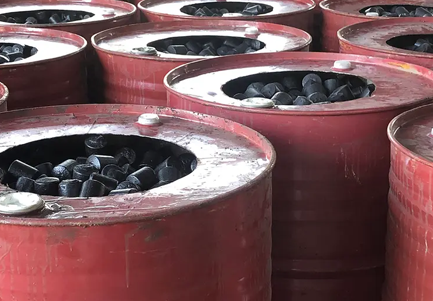
Selecting the correct media size requires precise mathematical calculations. You cannot rely on visual estimates. Industry standards dictate two primary equations for sizing your media effectively.
Initial feed size directly determines your starting media diameter. Engineers rely on the standard 10x rule. Feed particles should measure less than one-tenth the diameter of the chosen media. If you process 2.0 millimeter feed, you need a 20.0 millimeter grinding ball to crush it effectively.
Conversely, your target output dictates the minimum bead size. The expected ultimate particle size (D50) roughly equates to one-thousandth of the media size. If you need a final particle size of 2.0 microns, you must use 2.0 millimeter media. We can visualize these standard scaling relationships below.
Initial Feed Size (Max) | Recommended Media Size | Expected Output Size (D50) |
|---|---|---|
200 microns | 2.0 mm | 2.0 microns |
500 microns | 5.0 mm | 5.0 microns |
1.0 mm | 10.0 mm | 10.0 microns |
2.0 mm | 20.0 mm | 20.0 microns |
Media density must scale directly alongside slurry viscosity. High-viscosity fluids create significant drag. This drag slows down the internal motion of the media. If your media is too light for a high-solid-content slurry, a phenomenon called "media floating" occurs. The media literally suspends in the fluid. They fail to sink or collide. This entirely halts the grinding process. You must upgrade to denser materials like tungsten carbide when processing highly viscous pastes.
Running a single uniform ball size presents a massive operational risk. Uniform sizes limit your kinetic potential. Large balls excel at breaking coarse material. However, they lack the necessary surface area for fine grinding. Smaller balls provide massive surface area but cannot break large agglomerates. Therefore, you need a calculated size distribution. This media grading ensures large pieces crush heavy particles while small beads handle the ultrafine shear forces.
Material composition dictates your processing boundaries. You must define a strict baseline based on end-product purity limits.
Every milling process generates trace wear. Media friction sheds micro-particles into your batch. You must decide how much contamination your product can safely tolerate. Industrial mining often accepts trace iron. Pharmaceuticals demand absolute zero-metal environments. Your contamination threshold serves as the ultimate filter for material selection.
Metallic media dominates heavy industry. They offer exceptional impact strength and fracture resistance.
Carbon Steel: Highly economical and robust. They suit mining, cement, and non-sensitive chemical processing where trace iron remains acceptable.
Stainless Steel (304/316): These resist oxidation and chemical attack. They perform perfectly in food processing and mild chemical applications.
High-Manganese Steel: This alloy features a unique metallurgical trait. It literally work-hardens under intense impact. The outer layer becomes exceptionally hard while the core remains ductile and tough.
Advanced ceramics provide extreme inertness and specialized density profiles. They eliminate heavy metal contamination entirely.
Zirconia: Manufacturers stabilize zirconia using yttrium, cerium, or magnesia. Yttrium-stabilized zirconia offers unmatched wear resistance. It serves perfectly for pharmaceutical and high-energy milling requiring absolute purity.
Alumina: A cost-effective ceramic offering decent wear resistance. It works well for general laboratory milling and intermediate industrial tasks.
Tungsten Carbide: This material delivers maximum density. It transfers immense kinetic energy into the slurry. It breaks down the toughest materials quickly. However, it requires a significant upfront capital expenditure.
Chemical composition alone does not guarantee performance. The manufacturing route heavily impacts toughness and wear resistance. Production methods alter the internal microstructure fundamentally.
The eternal debate between cast and forged media hinges on microscopic physical traits. Forging relies on extreme mechanical pressure. Casting relies on phase changes from liquid to solid. These differences dictate how a grinding ball behaves under continuous impact stress.
Forged media typically demonstrate clear superiority in wet milling environments. The hot forging process applies immense compressive force. This pressure forcibly eliminates internal porosity. It closes microscopic gas voids. Furthermore, forging maintains unbroken metal flow lines throughout the sphere. These continuous flow lines act like physical grain in wood. They dramatically increase impact toughness and significantly reduce catastrophic breakage rates.
Cast media excel particularly in dry milling applications. Foundries pour molten alloy directly into spherical molds. This process allows for highly complex alloy mixtures, such as high-chrome formulations. Cast high-chrome balls achieve incredible surface hardness. They resist abrasive wear exceptionally well in dry cement and dry mineral processing.
You must observe a critical engineering caveat. High-chrome cast balls possess extreme hardness but inherently lower toughness. They are inherently brittle. This makes them highly susceptible to catastrophic brittle fracture in large-diameter mills. If your mill diameter exceeds three meters, the drop height generates massive impact energy. Brittle cast media often shatter under these extreme drop forces. You must switch to forged media or specially tempered cast alloys for giant mills.
Many procurement teams chase maximum hardness ratings blindly. They assume higher Rockwell Hardness (HRC) guarantees faster milling. This fundamental misunderstanding ruins processing efficiency.
Ultra-hard media face severe physical limitations. Maximum hardness does not equal maximum efficiency. If grinding media are too hard without adequate surface friction, they trigger an elastic rebound effect. The spheres strike the material, bounce off aggressively, and waste precious kinetic energy. The energy dissipates as heat instead of breaking the particle.
Furthermore, excessive hardness often leads to severe material slippage. Smooth, ultra-hard spheres fail to grip the target particles. The materials slide freely between the colliding spheres. They escape the critical shear zones entirely. A slightly lower hardness often provides the necessary grip to shear particles effectively.
You must shift your evaluation framework immediately. Stop looking purely at unit price per kilogram. Cheap media initially looks attractive. However, cheap media often results in accelerated wear rates. They lose mass rapidly. This forces frequent mill re-charging and increases overall downtime. Rapidly degrading media also spike electricity usage per batch. As the media shrinks, grinding efficiency plummets, forcing the mill to run much longer to achieve the target D50 size.
Any material selection must pair closely with regular wear data analysis. You must weigh your media charge periodically. Track the mass loss over specific time intervals. Compare this wear rate against the energy consumed. Without tracking these wear rates continuously, calculating true operational efficiency remains entirely impossible. Data-driven monitoring prevents unexpected system failures.
In laboratory environments or batch milling, you cannot select media in a vacuum. The media and the jar operate together as a unified system.
Hard media aggressively attack soft jars. Soft media degrade rapidly against hard jar walls. You must systematically pair compatible materials. Mixing incompatible harnesses destroys your equipment and contaminates your carefully prepared samples.
Engineers rely on established standard pairings to ensure system integrity. Follow these proven combinations:
Stainless Steel Balls + Stainless Steel Jars: This forms the ultimate general-purpose pairing. It handles high impact forces flawlessly. It works best for non-sensitive geological and chemical samples.
Zirconia Balls + Zirconia Jars: This creates a pristine, high-purity environment. It withstands aggressive milling while ensuring zero metal cross-contamination. It remains the standard for pharmaceuticals.
Alumina or Stainless Balls + Rubber-Lined Jars: This hybrid approach offers massive vibration dampening. The rubber lining absorbs excess shock. It proves perfect for processing highly fragile materials or noise-sensitive environments.
Strict regulatory compliance often dictates your material pairings. Consider environmental soil testing. Laboratories test soil for trace heavy metals. If you use stainless steel jars, you introduce rogue iron, chromium, and nickel into the sample. This invalidates the entire test. To solve this, technicians use PTFE (Teflon) jars paired with inert zirconia media. This specific pairing entirely eliminates heavy metal traces, ensuring perfectly compliant analytical results.
Selecting the optimal media demands a logical, step-by-step evaluation funnel. You must always start by defining your initial feed and target output size requirements. Next, strictly define your maximum allowable contamination limits to narrow down material families. Once materials are shortlisted, verify that the media density correctly matches your slurry viscosity to prevent floating. Finally, base your ultimate decision on measured operational wear rates and energy efficiency rather than initial upfront unit pricing.
We strongly recommend conducting a pilot test before upgrading your entire production line. Run a lab-scale trial using your newly calculated media size distribution. Monitor the wear rate, power draw, and final D50 particle size closely. This controlled testing validates your engineering assumptions before you commit to a full-scale mill charge.
A: Mixing sizes as part of a carefully planned distribution is absolutely required for efficient grinding. However, mixing different materials or randomly adding new sizes leads to disaster. The larger and denser balls will forcefully crush and destroy the smaller, softer ones.
A: High sphericity ensures uniform contact points and highly predictable wear patterns. Irregular shapes reduce kinetic efficiency and increase internal friction. Alternative shapes, like cylindrical "cylpebs," are used strictly in specific line-contact applications like bulk cement milling.
A: Agate or Yttrium-stabilized Zirconia remain the top choices for pharmaceutical processing. They offer extreme wear resistance and perfect chemical inertness. They completely eliminate the risk of heavy-metal contamination, ensuring compliance with strict health regulations.


